People are more likely to go to their dental appointment if they don’t have to fear pain and discomfort. Dental professionals have found new ways to make patients more comfortable during dental procedures. Dental offices are no longer using the same old drills that scared patients away. Newer technology has made it possible for dentists to use lasers and air abrasion instead of that dreaded drill. The technology is also more precise. Periodontics and root canals still require some drilling, and most people would be numb during that part of the procedure.
Dental Anxiety Is Common, Not A Personal Failing
If you cringe at the sound of a drill or shudder at a hygienist appointment, you’re in plentiful company. Two-thirds of UK adults share some level of dental anxiety, and many people feel too uncomfortable going in for a check-up until they experience pain. That’s why so many people stay away from the dentist’s office for months – or even years. The fear of the unknown can be worse than pain itself.
However, everyone has their own reasons for stalling. For some people, it all started when they were children. Maybe they experienced a particularly unpleasant injection, their dentist seemed to rush through the appointment, or a treatment lasted longer than expected. For others, a fear of needles often extends to dental care. And for many people, it’s as simple as being in a vulnerable position, with their mouths held open and unable to express themselves, which triggers a response to the loss of control, rather than thinking about pain. None of this is unfounded. It is a natural reaction to a situation that often led patients to feel helpless.
The Needle Isn’t What It Used To Be
If you ask anyone suffering from dental anxiety what they fear the most, it’s the injection. This is the most changed area. Computer-controlled anesthetic delivery systems – where the numbing drug is sent into the gum at a slow, steady pace rather than the sudden squirt of a syringe – have already made a big difference. In fact, it’s the flow of fluid into the gum that causes the pain in a traditional syringe, not the needle itself. Stronger topical numbing gels applied in advance of the needle going in, and many patients say they honestly don’t even notice it happening. A lot of it is the physical distraction of the needle, but if you take away that one moment of the needle actually pushing fluid into the gum, it helps.
Sedation Options For When Anxiety Runs Deeper
For patients who experience more severe anxiety, needle comfort won’t be sufficient. This is when sedation dentistry is used. Sedation dentistry isn’t a single solution. It takes many forms. Most people don’t realize that there’s a form of sedation for every level of anxiety rather than a blanket approach based on the procedure.
At the lightest end of the sedation spectrum is nitrous oxide (laughing gas). It takes the edge off anxiety but doesn’t make you unconscious. You’re still totally aware and in control and can legally drive yourself home afterward. But the sensation of impending doom drops considerably. Oral sedation involves taking a tablet before your appointment. For most patients, it leaves them feeling drowsy, relaxed, and with little, if any, memory of what went on. For serious cases, IV sedation puts you in a deeply relaxed, semi-conscious state over the course of a few minutes and for most of the next few hours.
The point isn’t that everyone needs sedation. The majority of patients don’t. It’s that even the most anxious patient, racked with genuine phobia, who hasn’t stepped into a practice in 10 years – can be treated with no risk and without experiencing anything like the ordeal they have in their mind.
Quieter Tools, Less Invasive Treatment
The sound of a drill can be triggering for many people, but luckily, dentistry has made considerable advances in this area. Nowadays, laser dentistry can be used instead of a drill or scalpel for various procedures, such as certain fillings, gum treatments, or to manage mouth ulcers. The laser produces less noise and vibration, and in many cases, stitches are not required after the treatment. Since the laser is more precise and affects less of the neighboring tissue, recovery is usually quicker as well.
In general, dentistry has been moving toward minimally invasive techniques, meaning that as much of your natural tooth structure is preserved, and the treatment is as gentle as possible. The less drilling, the less numbing, time spent in the chair, and discomfort after the treatment. For many people, the sound of the drill is associated with pain and subsequent visits, so opting for minimally invasive treatments can truly change their perception of a dental appointment.
Seeing What The Dentist Sees
Much anxiety related to visiting the dentist arises from a lack of knowledge about what is really going on in your mouth – although you can feel that something is happening and hear sounds, you are unable to determine if there is a serious problem or everything is fine. This problem can be solved directly by digital X-rays and intraoral cameras. The X-rays are now made with radiation that is minimal in comparison to the older film technologies and the results are immediately displayed, thus you don’t need to wait in uncertainty. Intraoral cameras are even more efficient: a microscopic camera lets you view your teeth on a screen that is located next to the chair in real time. Something that didn’t make any sense to you or made you feel uneasy (“there is a certain level of decay here”) can now be viewed and understood in detail by yourself.
Knowing what’s going on can alleviate much more of your anxiety than you may realize. The unknown is one of the main sources of fear and seeing exactly what is happening – rather than being asked to imagine it based on someone’s description – eliminates this problem.
Why The Right Practice Matters More Than The Right Mindset
Here’s the part that gets left out of most advice on “how to cope with dental anxiety”: you should not have to talk yourself into tolerating a ten-minute rushed appointment with a dentist you’ve never met before. High-volume, fast-paced settings are not designed with anxious patients in mind, and that isn’t a criticism of the dentists who work there – it’s simply a limitation of how they’re structured. Private dental care has the space to truly tackle anxiety: longer appointments, a named dentist who learns your history and your triggers over time, and a pace that doesn’t feel like you’re on a conveyor belt.
It’s why specifically seeking out a practice that specializes in anxious patients is often worth it rather than assuming any old dentist will do. Someone booking with a private dentist in Warwick, for instance, who says they focus on patient comfort and preventive care is likely to get more chair-time to ask questions, more freedom to tailor sedation to your preferences, and a dentist who remembers what worked for them last time. That continuity does a lot of quiet work behind the scenes in making your anxiety lessen over successive visits – you stop having to start from scratch every time with explaining your fear.
Communication That Keeps You In Control
Technology plays a part, but the real game-changer has been improving how dentists communicate. Many are now taught a method called “tell-show-do” – explaining in simple terms what you’re about to do, showing you the tool or process (often on a model or your own X-ray) and only then carrying it out. No surprises, no sudden sensations you weren’t warned about.
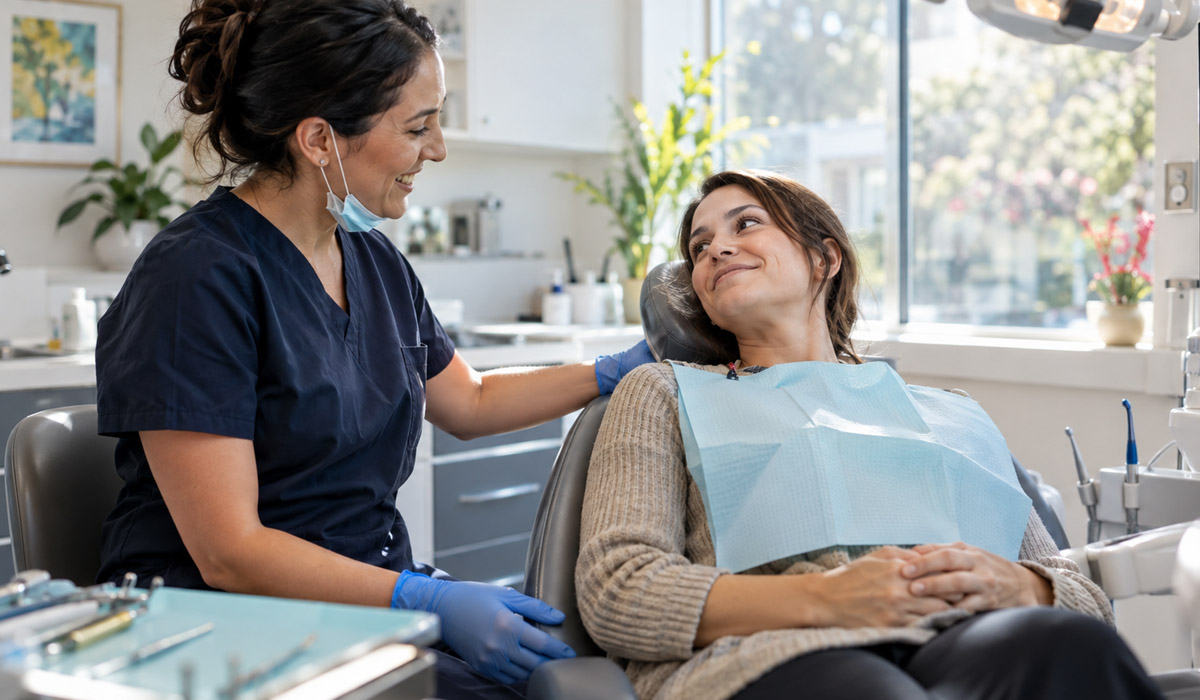
This is part of a broader shift to patient-centered care, in which your comfort and consent are just as important as clinical effectiveness. It’s apparent in subtle but important ways: dentists arranging a stop signal with you in advance that they agree to obey (raising a hand is the most common), allowing you to pause treatment without trying to talk around a mouthful of instruments. It’s evident in practices that raise the topic of your anxiety proactively rather than waiting for you to bring it up. And it’s evident in the room itself – soothing color schemes, soft lighting, noise-cancelling headphones available on request, waiting areas that don’t look too much like clinics.
None of this is window dressing. It’s a direct reaction to the knowledge that anxious patients don’t get treatment. And untreated teeth cause misery and ill-health for everyone.
Prevention Is The Real Long-Term Fix
Taking care of your teeth on a daily basis is still the most effective way for anyone to control their dental anxiety, as it’s the best way to prevent minor issues from becoming major ones. A good oral hygiene regimen – brushing your teeth twice daily, flossing, using interdental brushes, and reducing sugary foods – when combined with regular check-ups and professional cleanings, will greatly reduce the chances of needing an intensive, high-risk treatment. Treatments like fluoride and sealants provide extra protection, especially for those who experience tooth decay.
The above is important for reducing anxiety specifically because fear tends to increase with both uncertainty and invasiveness – two things that a small filling can prevent if detected early, and a root canal months later cannot. Also, bi-annual check-ups provide a low-stress view of the dental environment, which can help reduce anxiety over time, more than a one-time relaxation method can.
Some use cognitive behavioral therapy (CBT) to tackle the kind of catastrophic thoughts that tend to cause dental anxiety – for instance, “something will go badly wrong,” “I won’t be able to cope,” “the pain will be unbearable.” CBT won’t substitute for a good dentist, but in combination with one who already caters to anxious patients, it can help break down the structures of a fear that may have been building up over decades. Dental phobia support groups and online forums are also a good way to learn from others who’ve had similar experiences and still kept up with their check-ups.
Fear Doesn’t Have To Run The Show
However, none of this indicates dentistry has become pain-free or flawless. What it indicates is that the tools, the methods, and the people administering them have all indisputably improved and those old fears about going in for a check-up just aren’t as valid as they once were. The trick that works isn’t toughing it out. It’s discovering a surgery designed for patients such as you, outlining precisely what scares you before they do anything, and allowing the visit to progress at a speed that acknowledges that.