When the going gets tough (or soft, or steep, or deeply rutted), superior acceleration counts for little and that’s when careful riders on low-powered bikes tend to leave the high fliers behind.
Reading the terrain before you commit
Most serious errors on rough terrain occur because decisions are taken too quickly. Overly muddy holes and hills that pitch you over the bars or the rear wheel typically enticed you to evade a task many others have secretly skipped as well: scouting the line on foot. Before you ride or drive into a mud pit, get off the vehicle and walk it. Are there hidden ruts? Submerged logs? Depth that’s deeper than it seems from the seat? Ditto for a dune face or a hillcrest you can’t see over. If you can’t find a clear exit line, you don’t go. That’s not just a shrug of the dice, and it’s not being a wuss. It’s the difference between a challenging obstacle and an entire afternoon spent unburying an axle.
People who ride tough terrain without getting stuck or injured tend to walk even when it seems they’re doing nothing. They’re not just scouting, though. They’re storing up the habit that gives them years of trouble-free dirt riding. A hillcrest where you can’t see a run-out on the other side is a guess, not a line. Guessing on a several-hundred-kilo machine is called a rollover.
Sand: float, don’t plow
Sand is very different from hard-pack dirt, a lesson taught to the riders who someday dual-sport and grass-track race all spring and summer, but then come fall, flounder and flip in the loose, squirrelly stuff. The solution is to air your tires down before you even hit the dunes, to your machine manufacturer’s recommended minimum pressure. This increases the width of the tire, spreading the machine’s weight over a larger surface so it doesn’t sink as easily. On a dirtbike, an underinflated tire even helps a little by gripping more without sinking, the downside there being added sidewall flex with knobby tires maybe increasing the chances of a rolloff. Stand on the pegs with your knees bent for best results and if someone has a camera, tell him to point it at the guy who didn’t air down yet.
Body position is equally important and it’s pretty simple – think rear-biased. This keeps the front end light, like a ski rather than a shovel, from knifing into something soft. Proper throttle application is why rookies make so few dune faces before burying the machine, and the wrong approach is usually taking the machine’s cue the second it starts acting odd, and shutting off the throttle. This equates to simply going nowhere fast as you are actively taking away the force that would keep you moving in this soft, shifting surface. Conversely, the rider who panics and stabs the overly aggressive throttle buries the rear wheel in a spastic second and he’s toast anyway. The right amount of power is whatever it takes for the wheels to hit that dune’s summit without digging in.
Mud: momentum over throttle
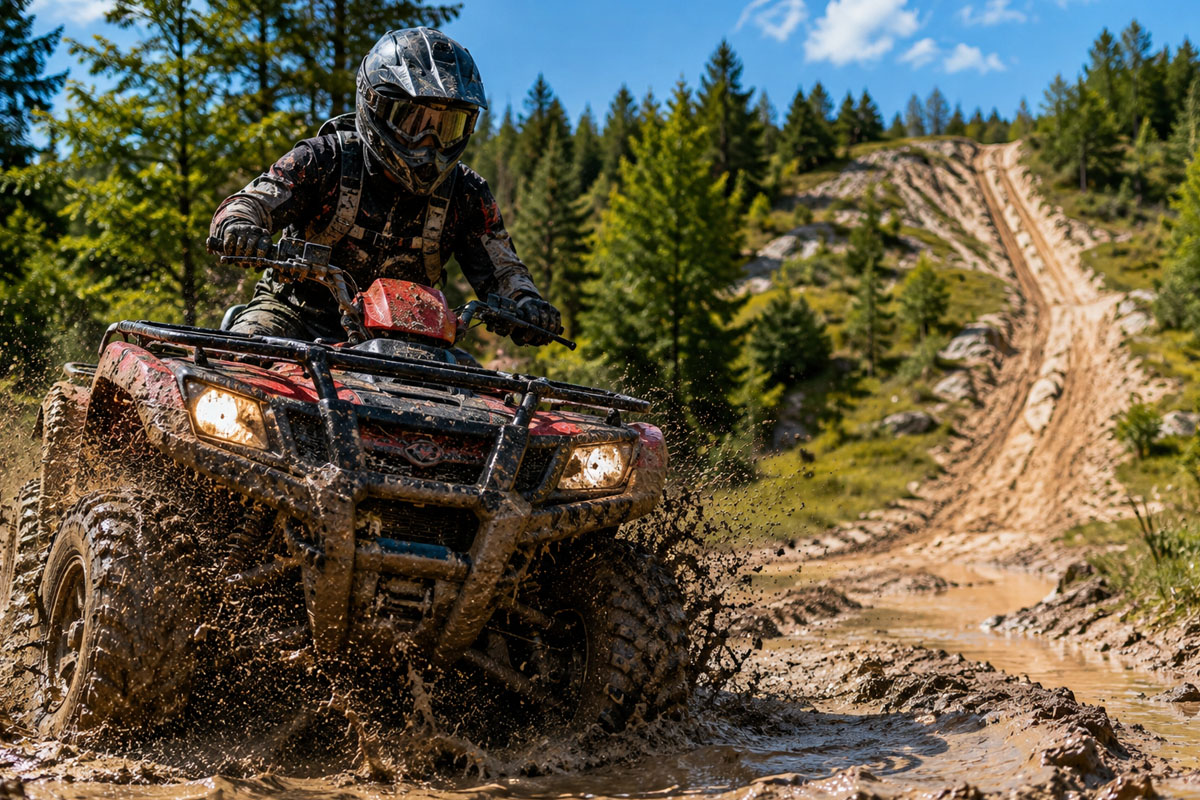
Mud punishes hesitation and impatience about equally. The goal is constant, steady momentum with the steering pointed straight ahead. The moment you feel the tires start spinning without the machine moving forward, that’s your signal to back off, not push harder. Spinning tires in mud don’t just fail to generate traction – they actively dig you deeper, sometimes to the point where the frame is resting on the ground and no amount of throttle will get you out.
This is where recovery gear stops being optional. A kinetic rope, a compact shovel, a set of traction boards, and a properly rated winch cover the majority of situations you’ll encounter. The mistake most riders make is buying this gear and never practicing with it. Figuring out where your tow points are and how your winch spools under load is not something you want to learn for the first time while up to your axles in clay with no one else around. Practice recovery in a low-stakes situation so it’s second nature when you actually need it.
Tire choice plays a bigger role in mud than most new riders expect. Self-cleaning knobby tires with widely spaced lugs shed mud as the tire rotates, maintaining a biting edge instead of packing solid with clay and turning smooth. Dedicated mud tires look aggressive for a reason – that tread pattern is doing real work every rotation.
Choosing a machine that makes the terrain easier
Technique helps level the playing field against a lot of variables, but your ATV doesn’t become magically suited for varied terrain just because you learned how to ride it better. Ground clearance is the single most important mechanical feature, because it literally changes which lines you can ride and which lines are impossible. Until you try to ride large logs or jagged rock outcrops, you won’t appreciate why the pros modify their ATVs to get every additional millimeter of clearance they can. A machine that high-centers on every obstacle simply stops you trying most of what you learn here.
Next up is the optional 4WD – optional when you’re actually serious about riding hard, but many riders think they are in the stickiest of situations and they just need more throttle. Momentum is the wrong answer here, you probably needed 4WD and now the answer is a winch, which probably also requires engaging the diff-lock you don’t have. After that, the option for low-range gearing isn’t optional at all, because you can’t steer a powerslide when you’re spinning out in high-range, and you can’t pick your way through baby-head rocks in a straight line in high range with the throttle feathered.
Finally, by the time you’ve ticked all the optional boxes the money is running out for a proper stress-engineered frame to transfer the inevitable winching stresses of steep and muddy hill climbs down to the right part of the ATV, rather than bending the whole chassis out of kilter. Raw horsepower doesn’t make it onto the list above, which hurts the feelings of some owners, but there’s no point to having raw horsepower when you’re high-centered on a rock or rooted out in a mud hole. If you’re in the market, looking at atv bikes for sale with these points in mind sets you up to have a good experience rather than buying for accent colours and relying on technique only.
Steep climbs: line choice and body position
To climb a steep grade, you need to prepare before you even touch the hill. Switch your vehicle into low range and 4WD before you hit the incline – if you wait until you’re on the hill to do it, you’ll lose the momentum you need to climb it in the first place. Next, pick a direct line up the closest section of the hill to its base. As the hill gets steeper, you’ll have to look for its nose, the straightest and most direct path up. Next, start driving up the hill. As the slope goes up and you find the front wheels rising, lean your body as far forward over the handlebars as you can. This will help keep the front wheels planted and driving, because if the front wheels start spinning, you’re going nowhere.
Steep descents: let the drivetrain do the work
Braking needs to be applied cautiously and neatly on descents, to reduce the likelihood of skidding which causes loss of control. Using the gearbox to control speed should be your first choice, reserving the brakes for minor speed corrections. It’s better to go too slowly on a descent and have to crawl your way back up than to go too fast and turn into a human missile.
Sidehilling: the hazard that causes the most rollovers
Traversing a slope at an angle (sidehilling) is consistently one of the top leading causes of ATV rollovers. If you have to cross a cambered or loose incline rather than just climb it straight, shift your body weight toward the uphill side and keep your pivot point (not your steering input) doing the work of correcting your line. Trying to fight a sidehill with sharp turns, instead of with optimal weight shift, is how a manageable crossing becomes a slide down the slope. If the incline gets steep enough that sidehilling feels unstable, that’s the terrain telling you to go find another route rather than push on through.
Matching drivetrain mode to what’s underneath you
Driving in 2WD is fine on flat, firm ground where you don’t need the extra traction, and it’s actually easier to steer through tight, technical sections. But as soon as you hit sand, hills, or deep mud, you need to engage 4WD – and the differential lock if your machine has one – to get traction that 2WD simply can’t provide. The trade-off is that steering feels noticeably heavier in tight turns, so switch back to 2WD once you’re through the hard stuff.
Fatigue is the hazard nobody talks about
Most near misses on tough terrain aren’t one catastrophic choice. They’re a rider out for too long, whose reactions have slowed, who then starts to make the sort of small mistakes that add up. One good indicator of that is your own body position: if you catch yourself riding with locked elbows, or a stiff, braced stance instead of the loose, ready position you began with, that’s fatigue getting a hold. Take a breather. Look at the next challenge with fresh eyes rather than plowing on.
And there are good reasons to put maximum day’s ride clear in your rearview mirror when you get that feeling. More than 100,000 ATV accidents require ED treatment in the U.S. every year (U.S. Consumer Product Safety Commission), with speed, fatigue, or overestimating a route you’ve never actually inspected accounting for a big slice of those. Far more likely ways to stay healthy: ground reading, your body position, and recognizing when you and the bike can’t clean a section so it’s time to regroup.
These trails don’t care how fired up you are or how many horses you’ve got under control. They can only be cleared by reading them, your capacity, and that V-twin. Master those and the water holes, silty corners, and impossible climbs cease to be all that stands between you and the route, and just another sweet part of the journey.