Starting a bouncy castle hire business can be an attractive opportunity for entrepreneurs looking to enter the events and entertainment industry. Children’s birthday parties, school celebrations, community events and family gatherings all create potential demand for inflatable attractions.
Unlike businesses that require permanent retail premises, a small inflatable hire operation can often begin with a limited selection of equipment and expand as bookings increase.
However, buying a bouncy castle doesn’t automatically create a profitable business. Transport, storage, insurance, maintenance and marketing all affect the initial investment and ongoing costs.
So, is a bouncy castle hire business worth starting? The answer depends on local demand, realistic pricing and how efficiently the business operates.
Why Bouncy Castle Hire Appeals to Small Business Owners
One advantage of inflatable hire is the opportunity to generate repeated rental income from the same equipment.
A commercial bouncy castle might be hired for a birthday party one weekend, a school event the next and a community celebration later in the season.
This makes the business model relatively straightforward: invest in suitable equipment, attract customers and manage bookings efficiently.
Another advantage is flexibility. Rather than purchasing a large collection immediately, new operators can start with a few popular designs and expand according to customer demand.
However, the business still requires suitable transport, secure storage, safe installation procedures and reliable customer service.
Success depends on more than owning attractive inflatables. Customers also expect punctual delivery, clean equipment and professional communication.
How Much Does It Cost to Start a Bouncy Castle Hire Business?
Startup costs vary depending on the equipment purchased, the scale of the operation and whether the owner already has suitable transport and storage facilities.
A small business offering children’s bouncy castles will have different requirements from one supplying large inflatable attractions for festivals.
The main expenses include:
| Expense | What to Consider |
| Commercial bouncy castles | Purchase price, size, durability and intended use |
| Blowers and accessories | Electrical requirements, anchoring equipment and spare parts |
| Transport | Suitable vehicle, fuel and loading arrangements |
| Storage | Secure, dry space for equipment |
| Insurance | Appropriate business and public liability cover |
| Inspections and maintenance | Routine checks, periodic inspections and repairs |
| Marketing | Website, advertising and customer acquisition |
An operator who already owns a suitable van and has available storage may face lower startup costs.
It is also sensible to maintain a financial reserve for repairs, cancellations and quieter periods.
The lowest initial investment isn’t always the most economical choice. Equipment that requires frequent repairs or replacement can increase long-term operating costs.
Which Bouncy Castles Should You Invest In?
Choosing the right equipment is one of the most important purchasing decisions.
Traditional bouncy castles are often a practical starting point because they can appeal to a broad range of customers, particularly families organising children’s birthday parties.
Compact models may suit smaller gardens, while low-height inflatables can provide opportunities for indoor events where venue dimensions allow.
Themed bouncy castles, including dinosaur, jungle and princess-inspired designs, may attract customers planning specific celebrations. However, highly specialised themes can have a narrower audience than neutral or multicoloured castles.
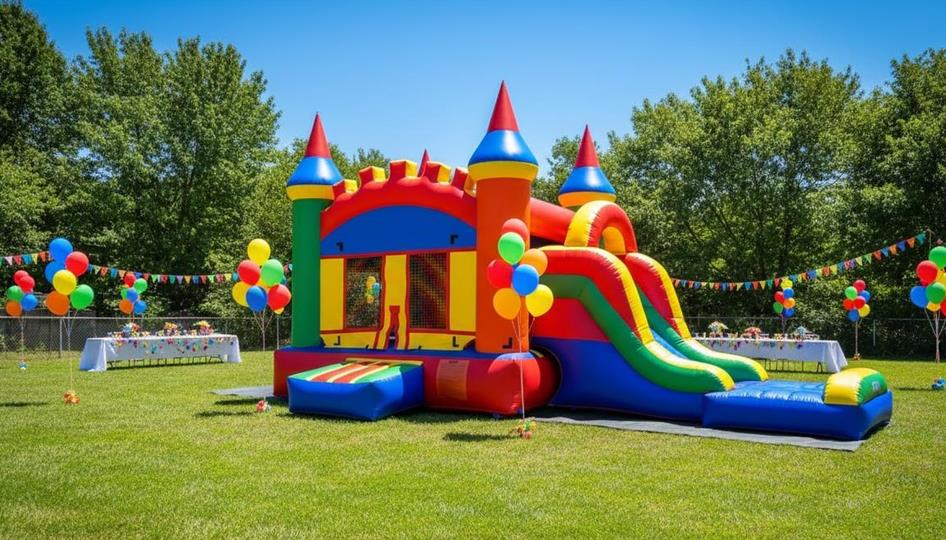
Combination bouncy castles with attached slides offer another option. They can appeal to customers seeking more varied entertainment but may require additional installation space and handling.
Rather than buying the most impressive-looking inflatable, operators should consider which designs suit the venues and events in their service area.
Why Commercial Quality Matters
Equipment intended for repeated hire must withstand regular transportation, installation, cleaning and storage.
Buyers should examine material specifications, stitching, reinforced areas, anchoring arrangements and operating instructions.
In the UK, BS EN 14960-1:2019 is an important safety standard for inflatable play equipment within its scope. Operators should check the relevant documentation and applicable inspection requirements before using equipment commercially.
Businesses researching commercial inflatables can explore manufacturers such as East Inflatables, which offers traditional bouncy castles, combination units and other inflatable attractions.
Before ordering from any supplier, buyers should confirm product specifications, warranty conditions, relevant safety documentation and after-sales support.
A durable inflatable that attracts consistent bookings may provide better long-term value than a cheaper model that requires frequent repairs.
How Much Money Can a Bouncy Castle Hire Business Make?
Revenue depends on rental prices, booking frequency, operating expenses and the number of inflatables available.
Consider a hypothetical operator charging £120 per booking and completing six bookings per month with one inflatable.
That would generate:
- Revenue per booking: £120
- Monthly bookings: 6
- Monthly gross revenue: £720
- Gross revenue over six months: £4,320
These figures are illustrative rather than actual market averages or guaranteed earnings.
Gross revenue is not profit. Operators must account for fuel, labour, insurance, advertising, maintenance and other business expenses.
A company completing several nearby bookings on the same day may operate more efficiently than one travelling long distances for individual events.
Understanding the contribution each booking makes after direct costs is essential when evaluating profitability.
How Long Does It Take to Recover Your Investment?
The payback period depends on the initial investment and the amount earned from each booking after variable costs.
For example, suppose a new business invests £3,000 in equipment and essential setup costs.
If each booking generates £80 after direct variable expenses, approximately 38 bookings would be needed to recover the initial £3,000.
This simplified calculation does not include additional fixed overheads, financing costs or taxes that may apply.
Actual results will depend on booking demand, pricing, competition and operating efficiency.
A business with consistent local demand may recover its investment more quickly than one with irregular bookings.
New operators should prepare conservative financial projections rather than assuming every weekend will be fully booked.
Is Bouncy Castle Hire a Seasonal Business?
Seasonality is particularly relevant in the UK, where outdoor events are affected by changing weather conditions.
Birthday parties, school fêtes and community celebrations can create opportunities during warmer months. However, rain, strong winds and unsuitable ground conditions may prevent outdoor installations.
Operators must follow the manufacturer’s instructions and applicable safety requirements when assessing weather conditions.
Indoor hire can help diversify the business.
Village halls, community centres and sports halls may provide opportunities during autumn and winter, provided the inflatable is suitable for the venue’s dimensions, clearances and anchoring arrangements.
Some businesses also introduce inflatable games, obstacle courses or other event equipment to broaden their services.
Diversification can create additional opportunities, but every new product introduces its own purchasing and operating costs.
What Are the Biggest Challenges for New Operators?
A bouncy castle hire business involves more than delivering equipment and collecting payment.
Transport and handling can be demanding, particularly with larger commercial inflatables. Operators need suitable vehicles, safe loading procedures and enough time for installation and collection.
Maintenance is another important responsibility. Inflatables need regular checks, cleaning and appropriate storage. Equipment should be properly dried before packing away to reduce the risk of material deterioration.
Insurance, inspections and safety procedures must also be considered. Requirements vary by location, so operators should understand the obligations applicable to their activities.
Competition can present a further challenge.
Customers often compare several local hire companies before making a booking. While price influences decisions, reliability, clean equipment, clear communication and professional service can also help a business stand out.
Competing solely on the lowest rental price may make it difficult to cover operating expenses.
How Can a New Hire Business Attract Customers?
Local visibility is essential because customers generally look for inflatable hire companies serving their event location.
A professional website should display clear photographs, equipment dimensions, suitable age ranges, hire information and service areas.
An eligible business can also use a Google Business Profile to help potential customers discover its services through local searches.
Customer reviews and recommendations can become valuable sources of enquiries, particularly when the business consistently delivers a reliable service.
Partnerships with event organisers, schools, community venues and party service providers may also help attract bookings.
Marketing should reflect the equipment available.
For example, a business offering compact children’s castles might focus on birthday parties, while an operator supplying larger inflatables could target school celebrations and community events.
As the business grows, reviewing customer enquiries can reveal opportunities to expand.
If existing castles are frequently fully booked, purchasing another popular model may be worthwhile. If customers regularly request equipment the business doesn’t offer, introducing a different design could make more sense.
Expansion should follow demonstrated demand rather than assumptions about future bookings.
Is a Bouncy Castle Hire Business Worth Starting?
A bouncy castle hire business can be a worthwhile investment for entrepreneurs who understand their local market and are prepared to manage the operational responsibilities.
The opportunity to generate repeated rental income from commercial equipment is appealing, but profitability is never guaranteed.
Equipment quality, booking frequency, transport efficiency, safety obligations, seasonality and customer service all influence financial performance.
For new operators, a sensible approach is to start with a realistic budget, choose versatile equipment and calculate how many bookings are needed to recover the initial investment.
Rather than building a large rental fleet immediately, focus on controlling costs, providing a dependable service and expanding in response to genuine customer demand.
A successful bouncy castle hire business is built not simply on owning inflatables, but on making sound investment decisions and giving customers a reason to book again.