Most bowhunters pick an arrowhead based on what performed well for someone else on a different animal in different terrain at a different distance. That approach works until it doesn’t, usually at the worst possible moment. The animal you’re hunting should be the first variable in that decision, not an afterthought.
Species Determine What the Tip Actually Needs to Do
A whitetail deer and a mature bull elk are not the same challenge for a hunting tip. They vary significantly in body mass, hide thickness, bone density, and the distance between the entry point and the vital zone. An arrowhead optimized for one can be genuinely inadequate for the other, and treating them as interchangeable is a decision that eventually catches up with a hunter.
Whitetail Deer
Deer-sized game is forgiving relative to most other species. The body cavity is accessible from multiple angles, hide and muscle resistance is relatively modest, and the distance from entry to vitals is shorter than on larger animals. That gives hunters more flexibility in tip selection. A wide-diameter mechanical that fully deploys at modest kinetic energy levels will create devastating wound channels on a broadside or quartering-away deer, and the larger blood trail makes recovery straightforward in most conditions.
Fixed-blade tips work just as well on deer and have the edge on steeper quartering angles or when shot distance or draw weight limits available energy. Neither choice is wrong for deer. The margin for error is large enough that either design, shot accurately and tuned properly, gets the job done.
Elk and Other Large-Bodied Game
Larger animals change the equation significantly. More mass, denser hide, heavier bone structure, and a larger body cavity that the arrow has to fully traverse to exit the far side all demand more from the tip. Pass-through penetration becomes a priority rather than a preference, since an exit wound creates a two-hole blood trail that dramatically improves recovery odds on an animal that might travel hundreds of yards before going down.
For this class of game, the penetration math tends to favor fixed-blade broadheads over large-diameter mechanicals. A fixed tip cuts continuously from entry to exit without depending on deployment, which means it doesn’t lose energy to blade-opening mechanics at the moment it needs all available momentum to push through dense shoulder or ribcage tissue. Heavier total arrow weight amplifies this advantage, since momentum carries the arrow through resistance in ways that pure speed doesn’t.
Wild Hogs
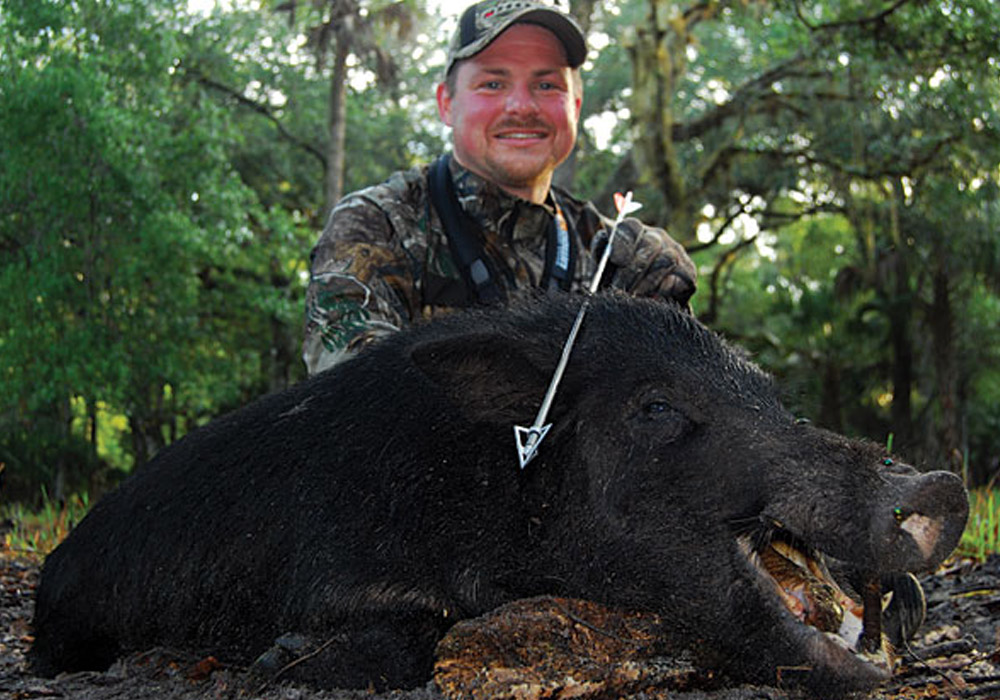
Hogs present a unique challenge. They’re not necessarily larger than deer, but their bone structure and the cartilage plate that runs along the shoulder can stop or deflect a poorly penetrating tip that would sail through a deer without hesitation. Hogs also move unpredictably after the shot, so an exit wound and a clear blood trail matter more than they might on a stationary deer.
The combination of penetration priority and need for reliable blood trails makes a cut-on-contact fixed blade a strong choice for hogs, particularly at the shoulder angles that hunters frequently encounter on animals that won’t stand still. Mechanicals can work on hog-sized animals but carry more risk if the shot isn’t perfectly placed or if the blade hits the shoulder plate on entry.
Why Shot Angle Changes Everything
Every species discussion above assumes a reasonably clean presentation. Shot angle is the variable that complicates all of it.
A broadside shot is the most forgiving for any tip. The entry angle is clean, the path to the vitals is relatively direct, and both fixed and mechanical options have a good track record. Quartering-away shots favor penetrating tips because the arrow may need to travel at an angle through the body cavity before exiting. Quartering-toward shots demand real penetration, since the tip needs to punch through chest muscle or shoulder mass before reaching the vitals.
Hunters who routinely encounter steep quartering angles, either because of their hunting style or the terrain they hunt, should weigh tip selection with those shot angles in mind rather than building a setup around ideal broadside presentations that might not materialize in the field.
Terrain and Recovery Conditions
This is an underappreciated factor. The right tip for an open field hunt where tracking is easy may not be the right tip for dense timber where a short blood trail can vanish into undergrowth after 30 yards.
When recovery conditions are difficult, cutting diameter and blood trail volume deserve more weight in the decision. When shot angles are predictably steep or the animals are large and tough, penetration depth takes priority. Most hunters are making this trade-off implicitly every time they choose a tip, but making it explicitly, thinking through what recovery actually looks like in the places they hunt, produces better outcomes than defaulting to brand loyalty or gear reviews filmed in controlled conditions.
Putting It Together Before the Season Starts
The right arrowhead for any given hunting situation comes from stacking these variables honestly: species, typical shot angles, draw weight, total arrow weight, and the terrain where recovery will actually have to happen. A hunter who works through that list gets to the right answer faster and with more confidence than one who picks based on marketing claims alone.
Conclusion
Species, shot angle, terrain, and your own setup are what should drive the arrowhead decision, not what worked for someone else on a different hunt. Work through those variables before the season rather than after a shot goes wrong, and you walk into the field with a setup that’s actually matched to the specific challenge in front of you.