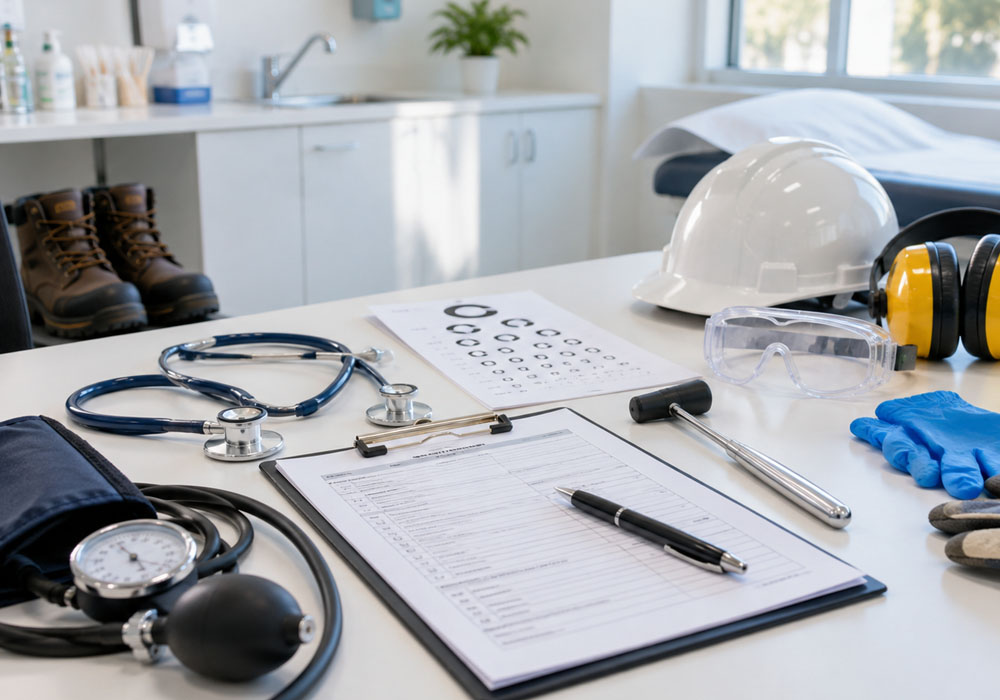
Most hiring mistakes in health screening do not come from testing too little. They come from testing the wrong things. A sound assessment matches the role’s actual demands, which helps protect Employee Welfare from day one.
Start with the job, not the form
A defensible assessment starts on paper before a candidate steps into a clinic. Employers should map what the role actually requires across a shift, then test against that map.
That map is often called a job demands analysis. It lists physical tasks, sensory needs, cognitive loads and environmental exposures in plain terms. It records weights, frequencies, postures, shift length, heat or cold, noise, dust, night work, driving and public contact.
Without that document, results have limited meaning. A doctor can report that blood pressure is high, but cannot say whether it affects the inherent requirements for a forklift operator on rotating nights compared with a part-time administrator working days. HR is left with a vague note and a hiring decision that feels like guesswork.
There is a reason cheap, generic medicals cause trouble. They assess everyone in the same way and return a basic fit or unfit result. That gives employers little information about aggravation risk or possible adjustments. It may also leave the employer open to dispute because the decision is not connected to the role’s actual tasks.
Spend time up front. Get the demands written down. It is usually the least expensive part of the process and gives every later decision a clearer basis.
Sort roles into risk tiers before you book anything
Not every role carries the same risk. Employers waste money when every candidate goes through the same battery of tests. That approach can still miss genuine hazards.
It helps to group roles into tiers. Office and sedentary work can sit in one tier. Retail and hospitality roles involving long periods of standing and light lifting may sit in a second. Warehousing, construction, labouring and delivery work with frequent heavy handling can form a third, while driving and plant operation, where an error may injure others, can sit in a fourth.
Healthcare and patient-facing work needs its own tier because infection control and patient handling create demands that are not present elsewhere. Remote and roster-based work also warrants a separate tier, as long hours, heat, isolation and limited access to care change what fitness for work means.
Tiers allow HR teams to match spending to risk. A desk-based hire may need a health questionnaire, basic checks, an ergonomic review and wellbeing questions. A heavy manual hire may require a full functional assessment, plus hearing and lung checks if dust and noise are present. A driver may need vision, hearing and cardiac review, along with drug and alcohol screening.
The labels do not need to be complicated. The principle is straightforward. High-hazard roles receive more testing, while low-hazard roles receive less. Each test should connect to the tasks recorded in the job demands analysis.
What heavy manual roles need
Heavy manual work can cause harm when the person and role are poorly matched. This includes warehousing, construction, labouring and delivery roles where workers lift, carry, push and pull throughout a shift.
A functional capacity evaluation is the core assessment for these roles. It provides direct observations rather than relying on assumptions.
Depending on the role, the candidate may lift boxes from floor to waist and waist to shoulder, carry items over a set distance, push and pull a sled or trolley, hold crouched or kneeling positions and repeat tasks to demonstrate tolerance. Results should be assessed against the job demands analysis rather than general population averages.
This matters because musculoskeletal disorders remain among the most common and costly claims employers encounter. An existing sore back may worsen in a role that requires constant bending without an appropriate plan. A shoulder with limited range may struggle with repeated overhead stacking. Screening cannot remove every risk, but it can identify where placement, training, job design or supervision may need to change.
The assessment can also establish a baseline. Current aches, previous sprains, reduced range and pain scores should be recorded before the start date. Photos, range measurements, grip scores and task notes may be useful later. If an injury claim arises six months after employment begins, the parties have information available for comparison. That can protect both sides.
Keep the approach practical. The aim is not to find elite fitness. It is to determine whether the candidate and the work can be matched safely.
What safety-critical roles need
When an error could cause serious harm, screening needs to be more specific. Relevant roles include truck and bus drivers, forklift operators and plant operators working near people, traffic, live power or public areas.
Vision and hearing are early priorities. Testing may cover distance and peripheral vision, colour vision where signals matter and night vision for work performed in darkness. Audiometry is common because workers must be able to hear horns, radios, reversing alarms and spotters over engine noise. Difficulty hearing warnings or reading signals may affect safe performance even when a candidate has extensive experience.
Medical history may also carry greater relevance. Assessments can ask about blackouts, seizures, heart events, sleep apnoea and diabetes control because sudden incapacity behind the wheel can have severe consequences. Blood pressure, pulse, cardiac risk review and sleep history may form part of this tier for the same reason. Drug and alcohol screening is also routine in many safety-critical settings because impairment increases other workplace risks.
This is where many HR teams work with an occupational health clinic that can tailor pre employment health tests to the driving, plant, night-shift and remote-site demands of each tier, instead of putting all candidates through one generic medical.
Requirements for retesting and clearance should be clear. If vision can be corrected with glasses, the report should say so. If a condition requires specialist clearance, that should also be stated. Fitness-for-duty decisions should not be left open to guesswork.
What healthcare and patient-facing roles need
Patient-facing work brings infection and handling risks that many other tiers do not carry. Relevant roles include nurses, aged-care aides, disability support workers and cleaners entering wards or clients’ homes.
Immunisation history is an early consideration. Records may be checked for hepatitis B, measles, mumps, rubella, varicella and flu, as well as any catch-up doses due. Blood work and infectious-disease screening may follow where exposure risk is high, including tuberculosis and hepatitis panels for staff with regular blood or sputum contact. The purpose is not to judge a person’s general health. It is to help protect patients who may be especially vulnerable.
Manual handling is another major component. Patient transfers can be awkward and heavy, involving beds, chairs, hoists, showers and falls recovery. An assessment may test grip, back strength, leg strength and tolerance for bending or holding, then compare the results with transfer tasks. Training helps, although baseline capacity still matters.
Respirator fit testing addresses another practical risk. P2 and N95 masks only work properly when they seal. Facial hair, face shape, model choice and mask size can all affect that seal. A prompt fit check can prevent problems later when staff need to enter isolation rooms.
All of this should be documented. Employee Welfare depends on clear records showing who is cleared for exposure-prone tasks and who may require limits or adjustments.
What desk-based roles still need
Desk work may appear low risk until prolonged sitting, screen use, sleep disruption and workload begin to take a toll. Some employees sit for eight to ten hours while managing deadlines with limited movement.
Ergonomic screening can identify early concerns. Reviewers may examine chair height, desk set-up, monitor distance, keyboard reach and mouse use, then observe posture during typing and calls. Small changes at the start may help prevent chronic neck or wrist pain later. If an employee has an existing back issue, the assessment can record helpful measures such as sit-stand rotation or lumbar support.
Basic health checks can still have a place. Blood pressure, fasting glucose, cholesterol and resting heart rate provide a snapshot that may prompt follow-up with the candidate’s own doctor where appropriate. Vision checks for screen distance and questions about sleep or shift-related fatigue can complete the picture. These results should not decide hiring on their own. They establish a baseline for care.
Stress and workload tolerance should be discussed in plain terms. Long screen-based days, on-call nights, tight turnarounds and blocks of overtime can affect focus and mood. Early support is often more useful than responding after an extended absence.
Desk-based hires should not be overlooked. Low hazard does not mean there is no hazard, and the level of screening should still reflect the actual role.
Make results lawful, private and usable
Tests should relate to real tasks, or they may create unnecessary risk. Anti-discrimination rules in most jurisdictions follow the same general principle. Employers should only act on health information that relates to the inherent requirements of the role. Rejecting a candidate because of a condition that does not affect safe work may invite dispute. Linking each question and test to the demands analysis supports fairer decisions.
Consent and privacy are the next priorities. Candidates should be told what will be tested and why, with written permission obtained before the assessment. Health information should be kept separate from general hiring files. Only the nominated decision-makers should have access to the medical report. Records should be stored securely, with limited access and clear retention periods that reflect privacy duties for sensitive information.
Employers should request reports they can use. A simple unfit result helps no one. A useful report states fit or fit with reasonable adjustments, with clear reasons for any applicable limits. Adjustments might include a lifting aid, roster change, screen filter or phased start. HR can then discuss practical options with the candidate. This supports Employee Welfare while keeping suitable people under consideration.
Pick a provider that works from job demands
Ask who performs the testing. Occupational health doctors, nurses, physiotherapists and exercise physiologists who regularly work with job demands may provide more useful reports than general clinics that only conduct occasional medicals. Request sample reports and look for task-linked findings and clear limitations rather than generic pass or fail statements.
Check turnaround times and service coverage. Many hiring processes cannot wait two weeks for an answer. Ask how quickly reports are returned and whether audiometry and spirometry are completed in-house for roles involving noise and dust. Confirm whether drug and alcohol screening meets chain-of-custody standards. For remote and roster-based placements, ask which additional checks are relevant to the role, roster and availability of local care. These may include cardiovascular, sleep or psychological health reviews when the job demands analysis supports them.
Choose a provider that can support the organisation over time. Ongoing medical surveillance for exposed workers and assistance with return-to-work plans after injury can reduce duplicated effort. A provider that retains baselines and monitors change may offer more value than a cheap one-off service.
Match each test to the work, maintain secure records, discuss limitations and consider reasonable adjustments before rejection. Employers hire people to perform real tasks in real workplaces. Screening should indicate who can do that work safely and what support may help them continue.