Military protection orders are a component of the general military response to domestic abuse. In 2023, the Department of Defense had 26,978 reports for domestic and child abuse, out of which 14,110 incidents were recognized as abusive by the DoD.
Within the larger American population, there were 1,110,040 cases of domestic violence victimizations, according to the Bureau of Justice Statistics, with 64% being reported to the police in 2024. These numbers were published in 2025 and indicate that protection is still needed in domestic violence cases.
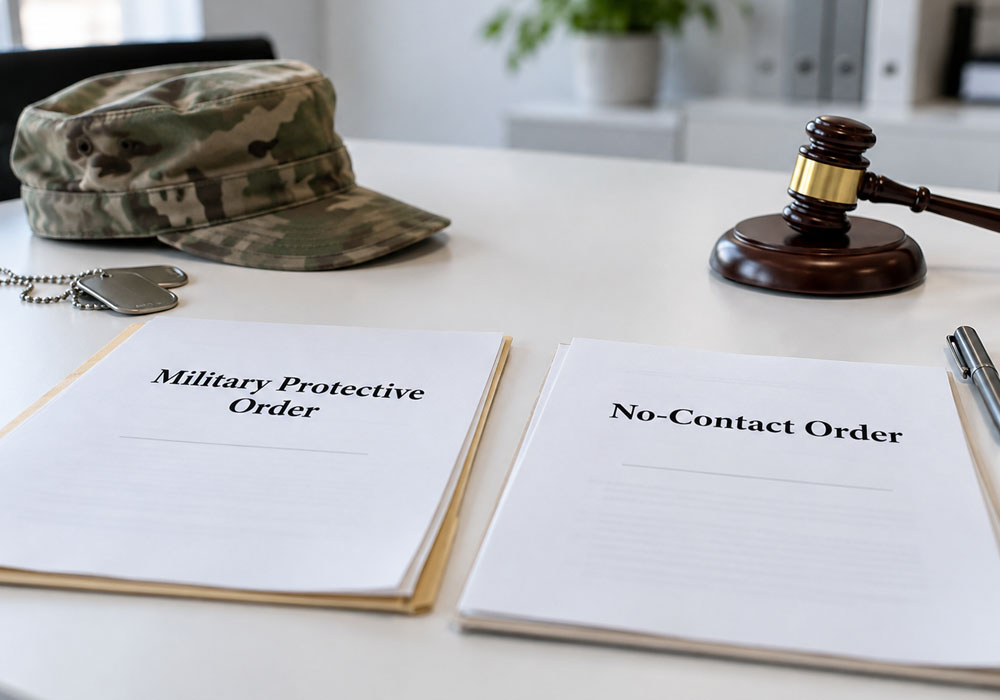
But what’s the difference between a no-contact order and a military protective order? A Military Protective Order (MPO) and a no-contact order can both be used to protect someone from unwanted contact or potential harm, but they are not the same.
An MPO is a directive that is ordered by a military leader in order to protect a domestic violence, child abuse, or sexual abuse victim and regulate the behavior of active duty military personnel. A no-contact order is an administrative measure that may include temporary restriction of communication and contact.
Under current Department of Defense guidance, a no-contact order should not replace an MPO when an MPO is warranted.
The main difference is how the orders are used, who issues them, and the protections they provide.
Two Systems With Similar Goals
Part of the confusion comes from the fact that “no-contact order” can mean two different things. Inside the military, a commander can issue one to a service member under their authority. Outside the military, a civilian judge can impose one, often as a condition of release in a criminal case.
A military protective order, or MPO, belongs to the first system only. It is a commander’s order too, but it is more formal and reserved for more serious situations.
The Commander’s No-Contact Order
The military no-contact order separates individuals in an efficient manner. The military no-contact order can be issued by the commander in case there is disruption in the unit, in case there are any ongoing investigations, or even when some time needs to pass.
Such orders are normally limited in scope, and the one issuing them may easily amend them or cancel them altogether. It is all dependent on the particular command and situation.
The Military Protective Order
MPOs are issued by commanders via DD Form 2873, and they tend to be common in incidents where there is domestic violence, sexual assault, or child abuse. The terms of an MPO may include restriction of communication and setting distances.
According to Fort Bliss guidance on off-post enforcement, an MPO stays in effect until the commander ends it. When a soldier transfers, the losing commander cancels the order, and the gaining commander may issue a new one. A violation can be punished under the Uniform Code of Military Justice, most often as a failure to obey a lawful order.
In addition to that, the commanders need to file the active MPOs in the FBI’s National Crime Information Center, as stated in the tip sheet provided by the National Crime Victim Law Institute. This would make sure that the orders are known to the civilian police when there is a record check on their part.
Civilian No-Contact Orders Work Differently
Civilian no-contact orders come from judges rather than commanders. In federal cases, avoiding contact with an alleged victim or a potential witness is one of the release conditions a court may impose under the federal pretrial release statute. State courts use similar conditions, though the details vary by jurisdiction.
These cases unfold in regular courtrooms, with prosecutors, defense counsel, and pretrial services officers involved.
In South Florida, federal matters are heard in the Southern District of Florida. Practitioners like Miami federal criminal defense lawyer Barry M. Wax handle a wide range of federal charges. The civilian process looks very little like a commander’s decision at the unit level.
Because a civilian order is issued by a court, a violation can bring consequences through that court, such as revoked release or new charges. That is a different path from the UCMJ process that follows a broken MPO.
Where the Orders Overlap and Where They Do Not
The most practical difference is enforcement. The Fort Bliss guidance notes that MPOs are not enforceable by civilian law enforcement. Police off the installation may notify the command of a violation, but they cannot arrest someone for breaking the MPO itself. A civilian protective order, by contrast, is enforceable everywhere, including on a military installation.
Another deficiency lies in the coverage of the orders. The MPO covers the person who is issued this document, and its coverage depends on the military status of that individual. However, civilian order has no dependency on continued service. It is for this very reason that the Army advises to consider securing both MPO and civilian order.
Duration and flexibility also differ. Commander-issued orders can change quickly as circumstances shift. Court orders, however, generally require a hearing or a formal motion to modify.
Looking Ahead
For service members, spouses, and partners, the label on an order matters less than the details inside it. Who issued it, who it binds, and who has the power to enforce it.
Anyone subject to or protected by one of these orders will get the clearest picture by reading the order itself closely and asking the issuing command, the court, or a legal assistance office how it applies to their situation.