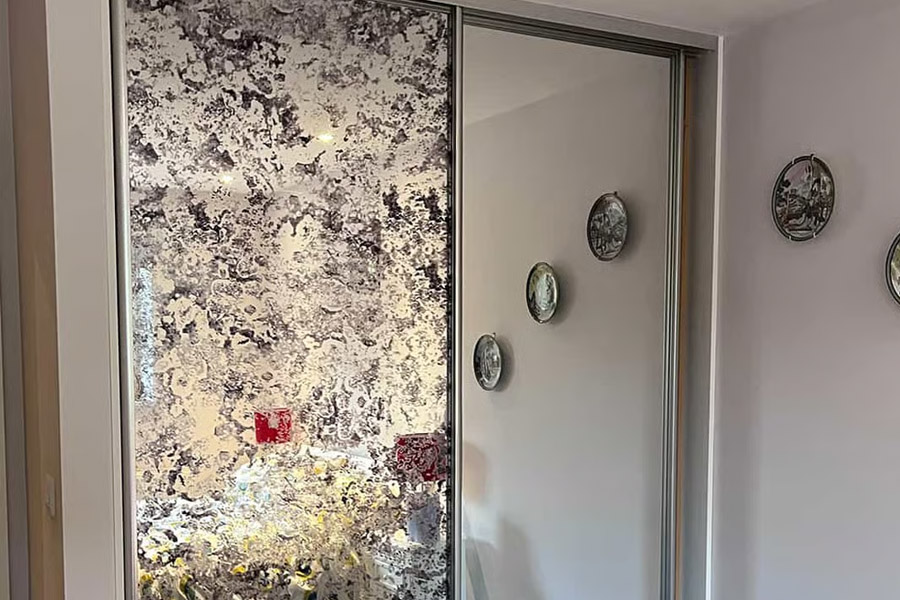
A mirrored wardrobe front in a bedroom does a useful job and looks like a gym. The reflection is total, the room appears twice, and every mark on the surface reads instantly.
Antiqued mirror solves the same problem differently. It still reflects, still bounces light into the room, still makes a small space feel larger. What it does not do is produce a sharp second copy of everything in front of it, which is usually the reason people are reluctant to specify mirror in the first place.
What Antiquing Actually Is
Antique mirror is mirror whose reflective backing has been deliberately treated to produce the mottling, clouding, and speckling that old mirrors develop over decades.
The look originates in a real chemical process. Nineteenth and early twentieth century mirrors used silver or mercury backings that oxidized over time, particularly where moisture reached them at the edges. The result was the familiar darkened patches and silvery spotting, and the visual effect was attractive enough to be worth reproducing intentionally.
Modern antiqued mirror is made by applying controlled chemical treatment to the backing, producing the patina in a manufacturing process rather than over fifty years in a damp hallway.
Patterns vary considerably. Some finishes are lightly speckled and read as almost clear from a distance. Others are heavily clouded, with large areas of darkened backing, and reflect more as a suggestion than as an image.
Tone varies too. Silver, gold, bronze, and smoked variants each shift the reflected color, which is the property that lets a mirror finish coordinate with a room’s palette rather than sitting apart from it.
The Reflection Is Partial, Which Is The Point
A clear mirror reflects accurately. An antiqued one reflects unevenly, with the patina interrupting the image across the surface.
That interruption does several useful things. It softens the reflected scene, so a cluttered room does not appear twice at full definition. It removes the mirror’s tendency to dominate a wall, because the surface reads as textured rather than as a hole. And it means the reflection is atmospheric rather than functional, which is appropriate for anywhere a mirror is decorative rather than something people actually use to see themselves.
That last point is also the limitation. Antiqued mirror is a poor choice above a bathroom vanity or anywhere the mirror has a job to do, because the patina obscures exactly the detail that a working mirror needs to deliver.
Doors Are The Application That Works Hardest
Specifying antique mirror doors for wardrobes, cabinets, or interior doorways addresses a specific problem: large door faces are visually heavy, and mirror lightens them without the harshness of a plain mirrored panel.
A run of wardrobe doors in antiqued mirror reads as a feature wall rather than as storage. It reflects light back into a bedroom, which matters in rooms that get limited daylight, while the patina keeps it from feeling clinical.
Cabinet fronts in kitchens and bars use it for the same reason. Glazed cabinet doors require the contents to be presentable. Antiqued mirror fronts reflect the room instead of revealing the shelves, which is why they turn up in bar cabinetry and butler’s pantries.
Interior door panels use it where a door needs to admit light and hold privacy, with the mirror finish adding a decorative element that clear or obscured glass does not.
Closet and dressing-room doors combine the light reflection with a surface that does not demand the maintenance a clear mirror on a heavily used door would.
Weight And Movement Are The Practical Constraints
Mirror glass is heavy, and a full-height wardrobe door in mirror is a substantial weight on its hinges or running gear.
Hinged doors transfer that weight into the carcass and into the wall behind it. Standard cabinet hinges are not always rated for mirrored fronts at full height, and the failure is gradual: the door drops, stops aligning with its neighbors, and starts catching.
Sliding and bypass systems handle weight differently and need track rated accordingly, plus a floor or head condition capable of carrying it.
Backing is the other consideration. Mirror on a door is subject to impact from the other side, and safety backing film applied to the rear holds the glass together if it breaks. For any door application, and particularly for full-height panels, that backing is worth specifying rather than assuming.
Pattern Matching Across Multiple Panels
This is where antiqued mirror installations succeed or look wrong, and it is decided at order stage.
Because the patina is applied as a treatment, the pattern varies from sheet to sheet. Two doors cut from different sheets will have visibly different distributions of mottling, and in a run of four wardrobe doors that inconsistency reads as a defect rather than as character.
Panels intended to sit together should be cut from the same production batch, and ideally the supplier should be told they are a matched set. Some fabricators will lay out cuts from a single sheet specifically so the pattern flows across adjacent panels.
The alternative approach is deliberate variation, treating each panel as distinct. That works if it looks intentional, which usually means the difference between panels has to be obvious rather than marginal.
Requesting a sample of the actual finish, rather than a catalog image, is essential here. Antiquing patterns photograph very differently from how they appear in a room.
Lighting Determines Whether It Reads
Antiqued mirror is highly dependent on how it is lit, more so than most finishes.
Under flat overhead lighting, the patina flattens out and the panel can look simply dirty rather than aged. Under raking or directional light, the texture catches and the surface comes alive.
Positioning relative to windows matters for the same reason. A panel facing a window reflects the window, which is generally good. A panel receiving side light shows its patina most clearly.
Rooms where the mirror will mostly be seen under artificial light at night behave differently from rooms used in daylight, and testing a sample in situ at both times is the only reliable way to know which finish suits.
What To Establish Before Ordering
Whether the mirror needs to function as a mirror, since antiquing rules that out.
Whether multiple panels need to match, and whether the supplier will cut them as a set from one batch.
What the door hardware is rated for, checked against the actual weight of mirrored glass rather than a standard panel.
Whether safety backing is included, particularly for full-height or high-traffic doors.
Antiqued mirror gives a room reflection without the second copy of itself. The finish is the easy part; matching it across a run of doors is where it goes right or wrong.