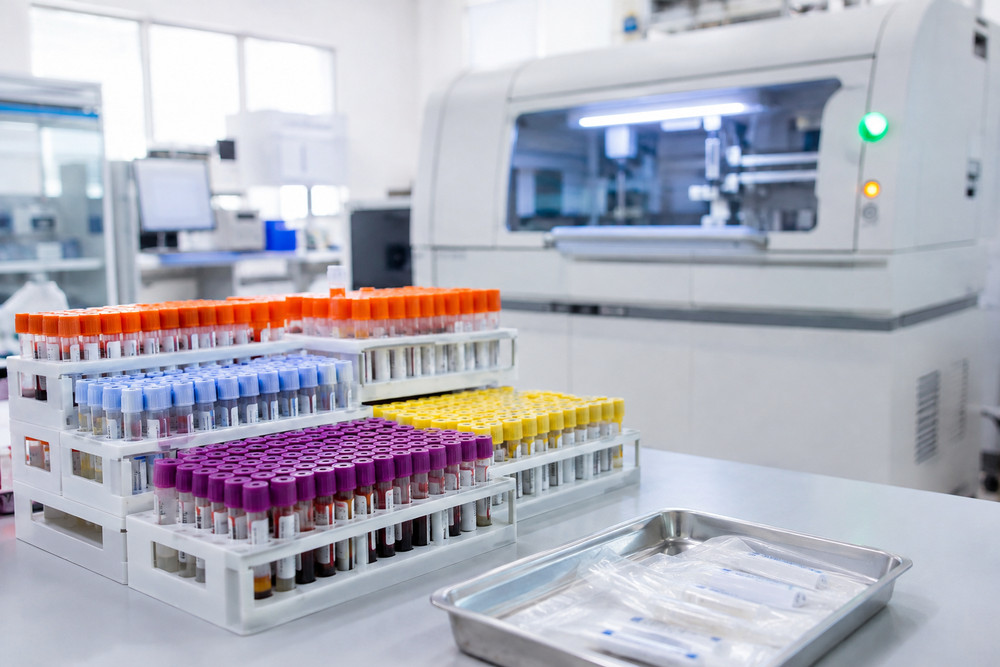
A sample spends very little of its life being analyzed. It spends most of it waiting: in a rack by the door, on a bench until somebody frees up, in a tray behind a plate that got there first. The analytical step the whole operation is named after is a small slice of the clock a clinician experiences.
When results run late, the instinct is to buy capacity. Another analyzer, another shift, another pair of hands. Sometimes that is exactly right. More often the instruments were never the binding constraint, so the new one ends up idling next to the old one while the queue stays precisely as long as it was.
Scheduling is the quieter lever, and it is the one most labs pull last. Deciding what runs next, on which device, in what order, with which dependencies respected costs nothing in capital and can move turnaround by hours. The catch is that doing it well is genuinely hard arithmetic, which is why software has taken the job over.
Queue Time Is the Real Turnaround Time
Labs that timestamp every handoff usually get a surprise. Most of the elapsed time between receipt and release turns out to be queue time rather than processing time, and queue time is invisible in instrument logs because nothing is running while it accrues. Nobody files a deviation for a tray that sat still.
Waiting is also cheap to create and expensive to carry. A single misordered batch pushes everything behind it, and the delay compounds down the shift rather than averaging out. Small sequencing decisions therefore have effects far out of proportion to how trivial they look at the bench.
Sequencing Beats Raw Speed
People schedule greedily. Work gets picked up roughly in the order it arrived, because that feels fair and requires no thought. A scheduler reasons differently: the assay with a ninety-minute incubation should start before the ten-minute one, even if it arrived later, since starting it early buys free time that the short assay can occupy.
This is a classic constraint problem, and humans are bad at it once the variables multiply. Five instruments, three technicians, a dozen protocols with different hold times and shared resources, and the possible orderings outrun intuition immediately.
Parallel Work Without New Hardware
Most labs run their steps in series out of habit rather than necessity. Prep finishes, then the run starts, then the read happens, then review begins. Yet very few of those steps genuinely block each other.
This is the core of what lab automation scheduling software contributes. It holds the dependency graph for every protocol, knows which resource each step needs and for how long, and interleaves work so that a robotic arm, an incubator and a reader are all busy on different plates at the same moment. Throughput rises while the equipment list stays exactly the same.
Adjustment When the Day Goes Sideways
A worklist printed at eight in the morning is a prediction, and predictions age badly. One urgent sample, one failed control, one instrument that needs a calibration it did not need yesterday, and the plan on paper no longer matches the lab in front of you. Static schedules fail not because they were wrong but because they cannot learn.
Dynamic rescheduling closes that gap by recomputing the order whenever reality shifts. Workflow standards assume exactly this kind of live coordination: IHE’s Laboratory Testing Workflow profile covers ordering, scheduling, pre-analytical processing and validation as one connected chain, with order status changes reported back to the ordering system as they happen rather than at the end.
Clean Data Is the Precondition
None of this works on ambiguous input. A scheduler needs to know what was ordered, on which specimen, with which priority, in a form it can parse without a human translating. That is why coded, structured orders matter more than they sound: HL7’s laboratory reporting guidance leans on LOINC and SNOMED CT precisely so that a test means the same thing to every system that touches it.
The integration side has improved too. A review in Clinical Lab Products argued that modern connectivity standards cut the time and cost of wiring each new instrument into a laboratory information system, work that used to run into the thousands of dollars per device through custom interfaces. Cheaper connections mean a scheduler can actually see the whole floor.
Where to Start
Begin by measuring, not buying. Timestamp receipt, prep start, run start, run end, review and release for two or three weeks, then look at where the gaps sit. The answer is frequently unglamorous, and it is frequently not the instrument everybody complains about.
Then pilot narrowly. Pick one assay family with steady volume and clear dependencies, let the scheduler run it, and compare against your own baseline before extending. Deliberate, phased rollouts are standard practice whenever a validated process changes, as manufacturers moving to new device coatings have found, and the logic transfers cleanly to workflow software.
The payoff is worth the discipline. Shorter turnaround with no new capital, instruments that earn their depreciation, staff who stop sprinting between steps that no longer collide. A lab that schedules well looks calmer than one that does not, and it is not because the work got lighter.