Here’s a scene that plays out more often than it should. A retailer’s demand model launches in March and everyone’s delighted. By September the forecasts fell off. Nobody can say which version is running, the data scientist who built it left in June, and the training data lives on somebody’s laptop. Not a disaster. Just an expensive stretch of detective work, repeated every quarter.
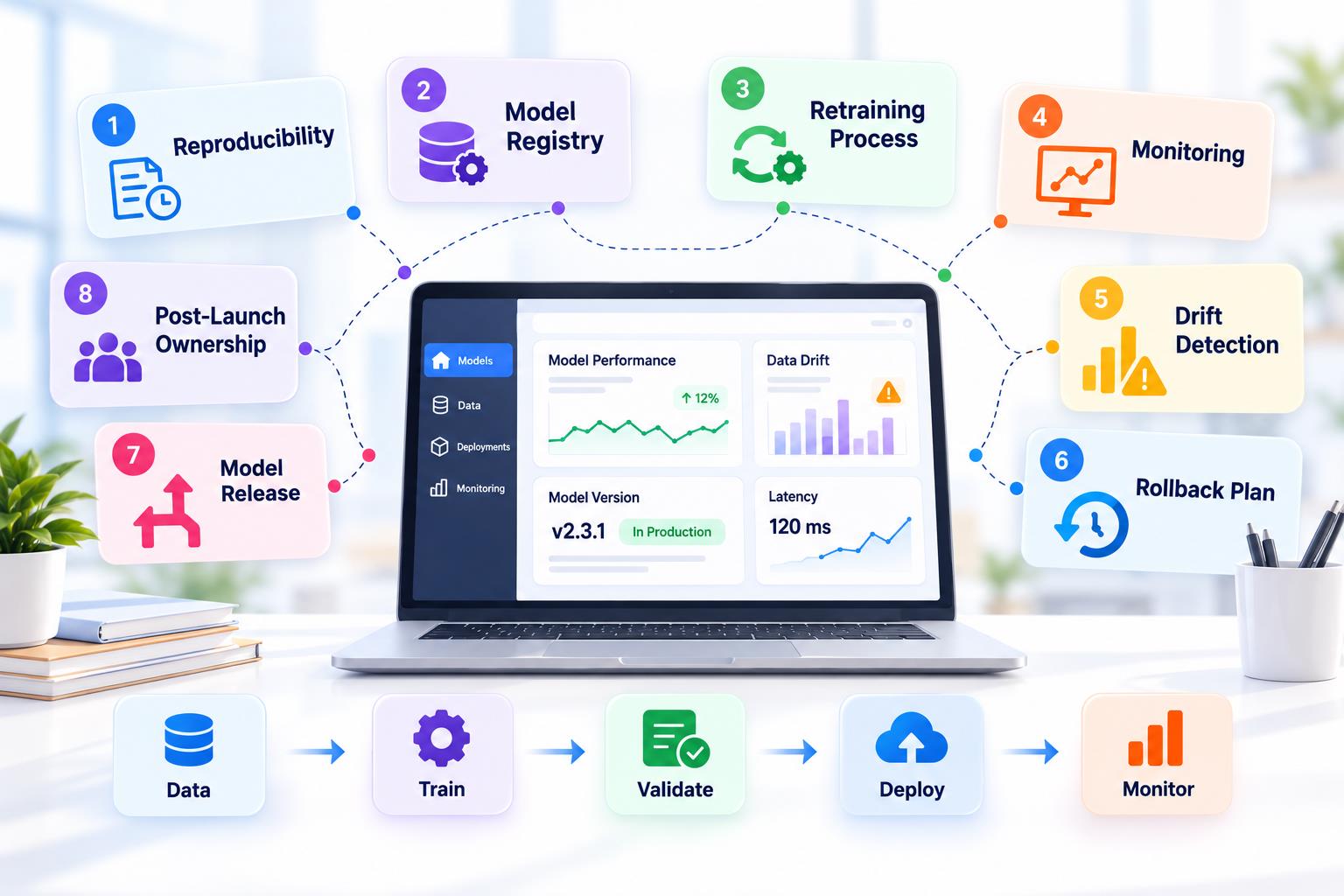
Building a first model is the easy bit, and plenty of vendors manage it. What separates them is the part after. So when you’re sizing up an ai ml development company, it pays to spend less time on algorithms and more on how they run things. Eight checks follow, roughly in the order trouble shows up.
1. Can They Rebuild Last Month’s Model?
A regulator wants to know why the model turned down one particular application back in spring. Answering that means rebuilding the model that was live on the day, with the data, code and settings it had then. Most MLOps guides repeat the same habit: checksum every training artifact, and record which data, code and config produced which model.
2. Is There a Model Registry?
The registry is the record of versions: who trained what, on which data, how it scored, where it’s deployed. Several MLOps guides treat it as the base for rollback, since nobody can go back to a version that was never written down. A shared drive full of files called final_v3_REAL.pkl doesn’t count. Plenty of teams try it anyway.
3. How Does Retraining Happen?
Google’s MLOps write-up describes three levels. Level zero is everything by hand: scripts run manually, models updated rarely because updating hurts. Level one automates the training pipeline, and retraining fires on a schedule, on new data or on drift. At level two the pipeline code itself gets tested and deployed automatically. There’s no single agreed scale, and a lot of what’s online just paraphrases Google’s original, so the labels are a loose guide. Small projects mostly land on level one. Level two on a three-month job would raise eyebrows.
4. What Gets Watched After Launch?
Most guides name three things to track. Latency and errors. Drift in the incoming data. And the quality of the predictions once real outcomes turn up, which takes a while: a loan default or a customer who quietly leaves can show up weeks later. Teams watch proxy signals in the meantime.
5. How Is Drift Caught?
Drift means production data has stopped resembling the training data. Watch only accuracy and you hear about it late. Compare input distributions and you hear early. The dull detail that matters: what threshold sends an alert, and whose phone buzzes? A name is a good answer. “The team” isn’t.
6. How Fast Can They Roll Back?
A bad model can cost more than a bad code release, so going back needs to be quick. It’s also fiddlier than usual. One guide points out that a model rollback may mean restoring the feature pipeline too, and a container redeploy won’t do that.
7. How Do They Release?
Canary releases send a small slice of traffic to the new model first. Shadow runs let it make predictions without acting on them. Either is encouraging. A plan that comes down to swapping the model on a Friday and seeing what happens is the opposite.
8. Who Owns It Afterward?
This is the one clients forget. The 2015 paper on hidden technical debt in machine learning systems makes a simple point: most of the lasting cost sits around the model, in pipelines, glue code and feedback loops. After handover somebody has to run that lot. Ownership, documentation and a runbook belong in the contract, because a promise on a call evaporates.
Where AI ML Development Hits the Budget
A quote with no MLOps line in it deserves a second look. Done properly, AI ML development puts a surprising chunk of its budget into plumbing. Some clients read that as padding. It’s the reason the model still works in month nine.
How an AI ML Development Company Handles Things Going Wrong
Ask about the last time something broke. Teams with real production time can tell you: a feed that died on a Tuesday, drift that went unseen for a month, a rollback that rescued a weekend. Without that history the answer drifts toward accuracy percentages. A good ai ml development company will take you through one incident, dashboard included, and doesn’t need prodding.
BiztechCS, which delivers AI/ML Development and GenAI Solutions for mid-market businesses, tends to begin with the data and the operating plan, and choose the model after that. A strong model sitting on a shaky pipeline still fails. Just later.