Choosing body jewelry is about more than how it looks. The way a piece is built, its measurements, and the metal it is made from all affect comfort, healing, and longevity. A ring that is too tight can create pressure points, while a barbell that is too short can dig in as swelling peaks. Closure style also matters because tiny edges or moving parts can irritate fresh tissue. This article explains how gauge, wearable length or diameter, and closure types work together. It also covers materials and early warning signs that your jewelry isn’t fitting well, so you can make informed, llow-riskdecisions for both new and healed piercings.
1. Gauge, Wearable Length, and Diameter: The Three Measurements That Matter
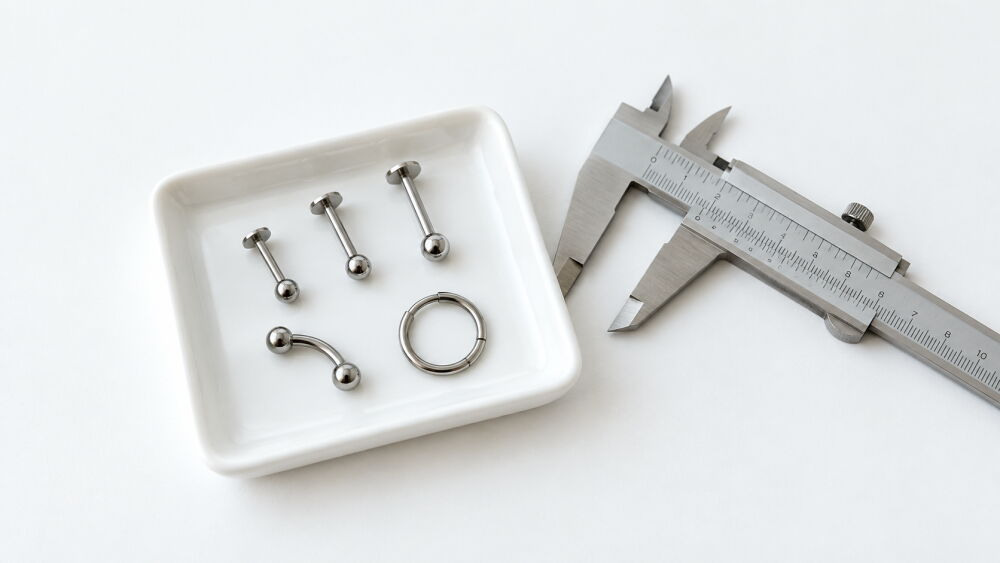
Gauge describes thickness. In piercing, a lower number means a thicker post, so 14g is thicker than 16g. Many piercings start at 16g or 14g to reduce the chance of cutting into tissue, then may be downsized when swelling subsides. Bars use wearable length, measured from the flat disc to the end, while rings use inside diameter. A fresh nostril or helix needs enough clearance for swelling and cleaning without leaving so much extra that the jewelry flips, catches, or presses at an angle. Reputable studios list these exact dimensions on their website, and the numbers are worth reading closely before you buy.
2. When a Stud Beats a Hoop (and Vice Versa) for Initial Wear
Movement and curvature change how jewelry contacts healing tissue. A labret stud distributes pressure with a flat disc and tends to move less, which is why straight posts or curved barbells are common starters for nostrils, cartilage, and navels. Hoops introduce curvature and constant micro-motion that can create a crease on the entry side if the diameter is too small. Consider two real scenarios: a nostril pierced with a hoop that hugs too tightly can leave an indentation and encourage an irritation bump. At the same time, a properly sized labret in the same spot keeps the channel stable during the early weeks. After full healing, many people switch to a hinged ring or clicker for style and easy cleaning.
3. Closure Mechanics: Threadless, Internally Threaded, Hinged, and Captive
Closures affect both installation and day-to-day comfort. Threadless systems use a tension fit pin that presses into a hollow post, creating a smooth surface through the piercing and reducing snag risk during insertion. Internally threaded barbells put the threads inside the post so the external surface that passes through skin is smooth, which helps minimize abrasion. By contrast, external threads can act like tiny files if they scrape tissue. For rings, hinged segment rings and clickers open and close on a built-in hinge, avoiding separate beads and offering quick changes once healed. Captive bead rings are secure and versatile but require popping a bead in and out, which can irritate an unhealed piercing or be tricky without ring-opening pliers. Trade-off to consider: a micro gem end may look delicate, but smaller contact points can loosen faster if you sleep on that side, so check tightness as part of your routine care.
4. Material and Finish: Titanium, Steel, Niobium, and Gold
Implant-grade titanium, commonly labeled ASTM F136, is widely used for fresh piercings because it is lightweight, nickel-free by spec, and can be anodized for color without coatings. Implant-grade stainless steel, labeled ASTM F138, is another established option, though it contains trace nickel and relies on a high-quality polish to remain skin-friendly. Niobium is naturally inert and can be anodized. For gold, choose solid 14k or 18k from reputable makers, and avoid gold plating or gold-filled for initial wear since thin coatings can wear away and expose base metals. Finish is as important as alloy: a mirror polish helps shed biofilm and reduces friction, while rough machining marks collect debris. Plastic acrylic balls and low-cost mystery metals often micro-crack or discolor with cleaning solutions, a poor match for high-motion areas like tongues and navels.
Spotting a Bad Fit Early and What to Do
Early indicators of poor fit include the disc or ball pressing a trench into skin, persistent redness where a ring’s curve contacts the entry point, or ends that sink into swelling tissue. A tongue barbell that felt fine on day one can become too short by day three when swelling peaks, leading to embedding. A helix stud with too small a disc can concentrate pressure and invite a tender, raised bump at the back. Solutions depend on the cause: a slightly longer post during swelling prevents embedding, a larger ring diameter removes a pressure crease, and a wider disc distributes force more evenly. Once swelling resolves, downsizing the post helps prevent snagging and angle stress.
Maintenance supports the fix. Rinse daily with sterile saline, avoid twisting or spinning the jewelry, and keep hair and fabric away from the area. For threadless ends, check that the pin has a slight bend and seats securely. For internally threaded pieces, gently check tightness with clean hands so the ends don’t back off during sleep. If pressure, heat, or discharge persist after an adjustment, or if you suspect migration, consult a professional piercer for a sizing review rather than forcing a change yourself.
Fit is not just a number on a product page; it is how gauge, length or diameter, closure, and metal interact with your anatomy and daily life. The right starter dimensions leave space for swelling and cleaning, then a timely downsize prevents chronic irritation. Smooth closures reduce abrasion, and high-polish alloys keep surfaces calm and easier to clean. Work with a professional piercer to measure accurately, schedule downsizing checks, and keep spare ends or O-rings on hand. With those habits in place, you can enjoy decorative clickers, charms, and gemstone ends once healing is complete without sacrificing comfort or safety.