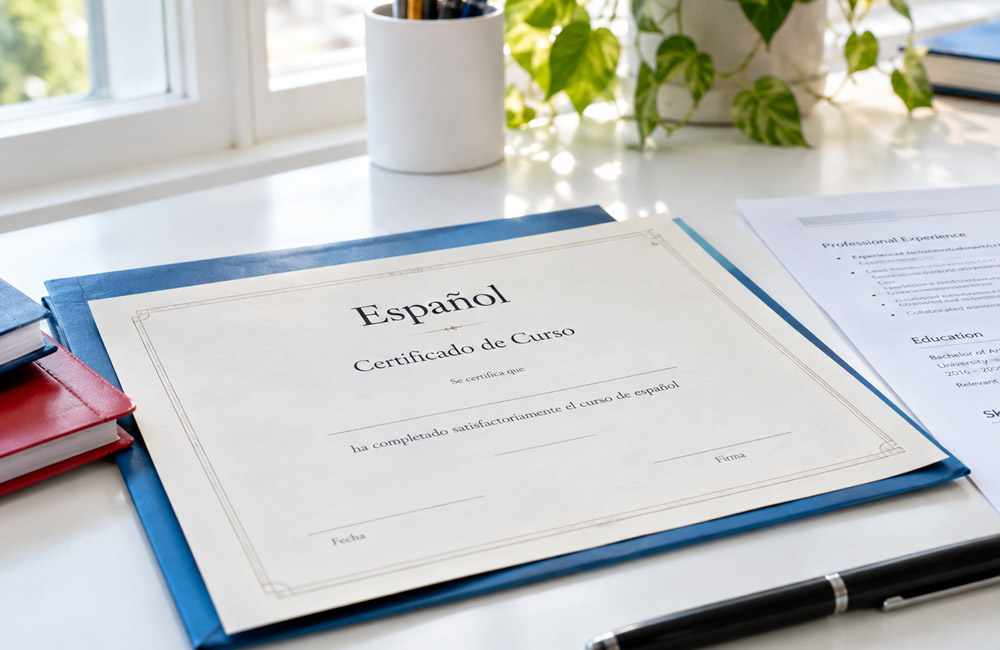
Employers rarely have time to guess how well you speak a language, and honestly, who can blame them? A clear result helps you stand out from a pile of similar CVs. A recognised certificate turns “I studied Spanish for years” into something a recruiter can check in seconds.
If you are unsure of your current level, a Spanish proficiency test is a sensible first step. Let’s look at the numbers, the usual hurdles and the practical ways to use your result.
Why Spanish Opens Doors Worldwide
Spanish now has more than 635 million speakers, according to coverage of the Instituto Cervantes 2025 yearbook. That is roughly one in thirteen people on the planet. Spanish-speaking countries contribute more than 6% of global GDP, according to 2024 Cervantes figures. Roles in sales, hospitality, healthcare and education often reward candidates who speak it. In my view, that makes Spanish a safe bet for your study time.
Where a Certificate Helps Your Career
A certificate can support several career moves, and these are the most common:
- Roles that list Spanish as a requirement become open to you.
- You can negotiate a language allowance or a better salary.
- University and study-abroad applications look stronger with proof of your level.
- Your CV and LinkedIn profile can carry verified proof of your skills.
- You can show a manager you are ready for international work.
Common Challenges Learners Face
Many learners struggle to judge their own level, and self-assessment is often unreliable. Others worry that an unknown certificate carries no weight with employers. Most people fix the first problem with a short CEFR-based test. They tackle the second by picking a certificate that recruiters can verify.
Check Your Proficiency with Testizer
Testizer offers a free online Spanish test that places you on the CEFR scale, from A1 to C2. It takes about 20 minutes and has 25 questions. A computer program scores the answers, so your result stays objective. You see your level immediately and can retake the test whenever you like.
If you are happy with it, you can buy a certificate that never expires. Each certificate carries a number and QR code so that employers can verify it. You can add it to LinkedIn or print it for your portfolio.
Choosing the Right Level for Your Goals
Different careers ask for different levels. Therefore, you must aim for the one that matches your role. B1 handles daily conversations in the workplace. The B2 level is ideal for professional communication.
C1 is the level of professional language skills, suited to demanding roles. Take a test first, then decide how much study you still need. Retaking it after a few months of study shows your progress.
Preparing Before You Sit the Test
A little preparation goes a long way. Revise the present, past and future tenses first, since A2 learners are expected to use them. Listen to a Spanish podcast on your commute (even ten minutes counts), and read short news stories aloud. Finally, take your test somewhere quiet, with a stable internet connection, so nothing interrupts you.
Making Your Certificate Work Harder
A result only helps if people see it, so try these steps:
- Place your CEFR level and test date near the top of your CV
- Add the certificate to your LinkedIn profile
- Mention it in interviews
- Retake the test as you improve
Final Thoughts
A Spanish certificate gives your skills a checkable label that recruiters trust. You should start with a Spanish proficiency test and share the result with confidence. Testizer makes that first step quick. Try it today and see your standing.