Three seconds. That is roughly how long it takes a room to go from normal to unlivable, and I want you to sit with how little time that is. Not enough to open the manual. Barely enough to stand up.
Here is the good news, and it is genuinely good: your ability to get yourself out of that room is not a personality trait. It is a trained reflex, and reflexes are built the same way whether you are a firefighter or a hotel manager who went on one safety course two Novembers ago. The gap between people who get out and people who freeze is almost always repetition, not courage.
I will walk you through how escape training actually rewires your response, what a realistic practice session looks like, and the specific drills I would run first if I only had one afternoon. You will also see why most safety briefings fail their audience, and what to do about it in your own building.
Why Your Brain Defaults to Freezing
Your brain runs on prediction. When a fire alarm goes off and nothing in your memory connects that sound to a practiced action, your system treats the moment as pure novelty and stalls. You look around. Everyone else looks around. That collective pause is the most dangerous few seconds in any emergency.
The fix is to give your memory something to grab. When you have physically walked to the exit, felt the door, and stood in the assembly area, the alarm stops being novel. It becomes a cue for a known sequence. Emergency planners call this recognition primed decision making, which sounds academic until you watch it work. The Centers for Disease Control and its workplace safety materials make the same argument in plainer language: what a person has practiced is what a person can do when thinking gets expensive.
Here is my stance, and I will not hedge it. Anyone responsible for other people in a building, which means most managers, most teachers, most shift supervisors, has no business skipping hands on escape practice. Reading a laminated card is not training. Walking the route is training.
What Self Escape Training Actually Trains
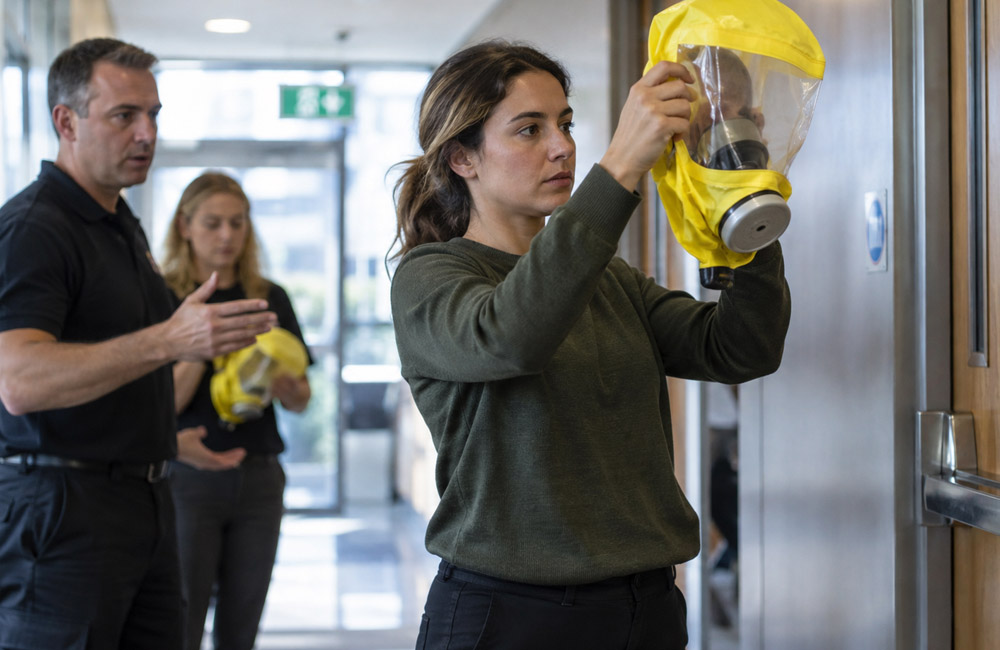
The clearest way to think about this is to look at how much gear the person is expected to carry. Escape that depends almost entirely on the person is a different skill set from escape that depends on supplied air. The gear side of that spectrum includes compact escape units and Self Rescue sets, and those exist because some environments run out of clean air before they run out of building.
Whatever sits in your kit bag, the underlying skills are the same four:
- Noticing the signal, and knowing which signals mean leave now rather than wait for the second alarm.
- Knowing which way you are facing when smoke or darkness erases the landmarks you rely on.
- Route selection. Picking a second path in under a breath because your usual one is blocked.
- Exit discipline. Leaving without stopping to collect anything or check on anyone you were not assigned to check on.
Train those four and you have something real. Train none of them and you have a signed form.
Do You Need a Full Training Program, or Is Practice Enough?
Practice alone gets you most of the way. A full program gets you the rest. The difference shows up in the parts that are hard to invent on your own: choosing the right escape route under strain, handling a door that is warm to the touch, and knowing how your specific escape device works before you need it.
If you manage a site, the honest answer is that you want both. Run the practice, and get the curriculum written by someone who has actually stood in a burning structure. When you outsource that, be picky about who you buy from. Ask whether their people have operated in the situations your people might face. Most suppliers of emergency equipment are warehouses with a catalog. Some of them are staffed by former responders. The second kind is worth the phone call. For an individual, a weekend course plus quarterly walks of your own route is plenty. I would rather you do the small version consistently than aim for the gold standard and never start.
Build the Habit Loop That Works in Real Conditions
Repetition only helps if it happens under something resembling pressure. If you rehearse in silence, with the lights on, and with a cup of coffee in your hand, you are rehearsing a situation that does not exist.
The U.S. National Institute of Standards and Technology has spent years studying how buildings and their occupants behave during fire events, and its research keeps landing on the same conclusion: the time people spend before they start moving is the variable that decides outcomes. You are training to shrink that pre movement window. Nothing else you do matters as much.
So add small stressors. Stand up when the alarm sounds instead of finishing your sentence. Alternately, practice with the lights low. Take the exit you never use. Do it with your coat on so your body learns the route in the condition you will actually be wearing.
Roughly one in three people will do nothing at all when an alarm sounds, based on what emergency researchers have observed in real evacuations, and that statistic should annoy you as much as it annoys me. It is a training failure, not a courage failure.
An Afternoon Drill You Can Run This Week
Block the time. Ninety minutes gets it done.
- Walk your primary exit route and count the doors from your desk to outside. Write the number down. You will be surprised how wrong your first guess was.
- Walk a second route. If the first one is out, this is your path.
- Find the nearest extinguisher and the nearest alarm pull, and note how many steps each is from where you sit.
- Close your eyes for ten seconds, open them, and point to the nearest exit. If you cannot point accurately, you have found your weakness.
- Sit your team down and ask each person to describe their route out loud. The ones who hesitate need another lap.
Run this quarterly. Put it in the calendar with the same seriousness you give a budget review, because an afternoon spent walking is cheaper than any outcome that follows not walking.
What Good Training Gets Wrong
Most safety programs hand out information and call it instruction. The distinction matters. Information lives on a page. Instruction lives in your legs. Effective escape training is judged by behavior, not attendance. Can the person state their exit route from memory? Have they done the route in poor light? Do they know where the assembly point is and who counts heads when they arrive?
Behavioral standards like the ones published by the World Wide Web Consortium for accessibility make a useful analogy here: a standard only works when you test against it, not when you simply publish it. Same with escape drills. Untested means unlearned.
One more thing worth saying plainly. Panic is not the enemy. Waiting is the enemy. People who move early rarely have to be brave, because they never let the situation get to the point where bravery is the only option left.
The Part Worth Remembering
Escape competence is ordinary. It is route knowledge, a rehearsed response to a specific sound, and enough repetitions that the decision happens before the thinking does. You can build all of that in a few afternoons a year, and it will still be there the one time it counts.
So here is your question for this week. If the alarm went off in the next ten seconds, where would you go, and how sure are you? If the answer has any hesitation in it, you already know what to put on your calendar.