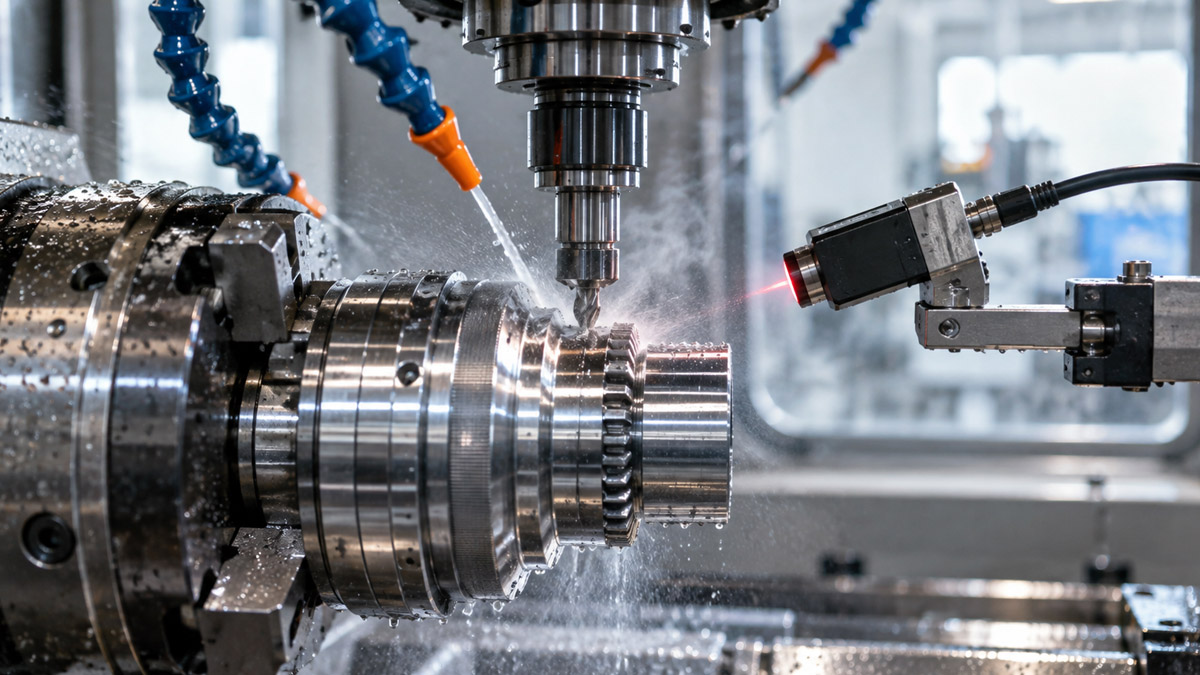
When I look at the machine-tool market in 2026, I notice buyers asking increasingly sophisticated questions.
They still want to know spindle speed, axis travel, table capacity, positioning accuracy, and cutting power. Those specifications have not disappeared.
But I think another question deserves much more attention:
Will the machine hold the same accuracy after it has been cutting for several hours?
That sounds simple, yet it reaches deep into machine design.
A machine can produce an excellent first component in the morning and still create problems later in the day if heat changes the relationship between the spindle, tool, workpiece, and machine structure.
For me, that is why thermal stability is becoming one of the most interesting subtopics in precision machining.
It is not as visually dramatic as watching chips fly across a showroom floor. There is no spectacular moment when thermal stability announces itself.
It works more like the foundation beneath a building.
You notice it most when it is missing.
Why I Am Paying More Attention to Thermal Stability in 2026
The timing is important.
U.S. manufacturing technology orders reached $605.8 million in July 2026. That was 55.2% higher than July 2025, while orders during the first seven months of the year totaled $4.03 billion, up 37.1% year over year.
The first half of 2026 had already produced exceptionally strong machine-tool investment. What interests me is that buyers are not simply adding equipment. They are investing in production capability that has to remain useful for years.
That changes the conversation for any CNC machine manufacturer trying to demonstrate long-term value.
The discussion cannot stop at maximum spindle speed, motor power, axis travel, or rapid traverse.
Customers increasingly want to understand what happens after the machine has been working continuously.
Does accuracy remain predictable?
Does the machine require frequent offset correction?
Does surface quality change as temperatures rise?
Can the machine hold tolerance across a long production shift?
These questions move thermal stability from an engineering detail into a commercial issue.
Accuracy on a Specification Sheet Is Only the Beginning
I often think there are two versions of machine accuracy.
The first is catalog accuracy.
The second is production accuracy.
Catalog accuracy tells us what a machine can achieve under defined conditions.
Production accuracy asks something more difficult:
Can it continue producing acceptable components while spindle temperature changes, ballscrews warm up, coolant temperature moves, ambient shop conditions fluctuate, and the machine experiences hours of continuous cutting?
That is where machine design starts showing its character.
Imagine two machines capable of producing the same dimension during an acceptance test.
Machine A requires frequent offset adjustments as the day progresses.
Machine B remains dimensionally predictable for much longer.
On paper, their specifications might appear close.
On the factory floor, they can feel like two completely different investments.
For experienced buyers, that difference matters because a headline accuracy figure does not always describe how the machine behaves under real production conditions.
What Can Influence Dimensional Stability?
| Factor | What can change | Possible production effect |
|---|---|---|
| Spindle temperature | Spindle and bearing dimensions | Tool position can shift relative to the workpiece |
| Ballscrew heating | Axis geometry and positioning behavior | Dimensional drift during extended operation |
| Machine casting temperature | Structural dimensions | Relationship between cutting point and workpiece changes |
| Coolant temperature | Workpiece and machine temperature | Variation in part dimensions |
| Ambient shop temperature | Entire machine structure | Different results between morning and afternoon |
| Cutting load | Heat entering tool, spindle, and structure | Greater variability during demanding cuts |
| Machine rigidity | Deflection under cutting forces | Size, geometry, finish, and tool-life problems |
None of these factors works entirely alone.
That is why I consider thermal performance a system-level engineering problem rather than a single-component feature.
A manufacturer cannot simply cool one area of the machine and assume the entire thermal problem has disappeared.
Spindle design, ballscrew behavior, structural symmetry, coolant management, lubrication, controls, and compensation strategies all influence what eventually happens at the cutting point.
Why Machine Design Matters More Than Marketing Claims
Terms such as high precision, high rigidity, and stable machining appear frequently in machine-tool marketing.
I understand why.
They are qualities every buyer wants.
But I think sophisticated customers increasingly want to know the engineering story behind those words.
If a supplier claims strong thermal stability, I would want to know how that stability is achieved.
Is the spindle temperature actively controlled?
Are critical heat sources isolated?
How is the machine casting designed to respond to thermal expansion?
Are ballscrews cooled or compensated?
How is coolant temperature managed?
Does the control use thermal compensation based on sensor data?
What happens during a long cycle?
A technical buyer may not expect every answer to involve an exotic technology.
What matters is that the design has a logical approach.
The strongest machine is not always the one with the longest feature list.
Sometimes it is the machine whose design decisions make sense together.
Rigidity and Thermal Stability Are Closely Connected
Thermal stability should not be considered in isolation from rigidity.
If thermal stability is about keeping machine geometry predictable as temperatures change, rigidity is about keeping that geometry predictable when cutting forces arrive.
I like to think of it this way:
Heat slowly moves the target. Cutting force tries to push the arrow away from it.
A well-designed machine has to resist both.
A rigid structure can reduce deformation under load. This becomes especially important when machining difficult materials, using large tools, taking heavier cuts, or maintaining long tool engagement.
Machine builders therefore have to make decisions involving casting geometry, guideway configuration, spindle construction, bearing selection, ballscrew placement, axis support, cooling architecture, lubrication, thermal compensation, feedback systems, and control algorithms.
Customers may never see most of these details.
Yet these are often the details quietly determining whether the tenth component resembles the first and whether the thousandth still falls inside tolerance.
Repeatability May Matter More Than One Impressive Accuracy Number
This is where I think buyers should change the way they compare equipment.
A spectacular accuracy figure attracts attention.
But manufacturing is repetitive by nature.
One perfect component does not create a profitable process.
Consistently acceptable components do.
That makes repeatability, thermal behavior, and process stability especially important.
A manufacturer might demonstrate one impressive test part at an exhibition, but I would be equally interested in what happens after the machine has been running for six or eight hours.
That is when production reality begins to replace showroom conditions.
Questions I Would Ask When Evaluating a Precision Machine
| Question | Why I think it matters |
|---|---|
| How is spindle temperature controlled? | The spindle is one of the primary heat sources |
| How does the structure respond to thermal growth? | Compensation cannot solve every structural issue |
| Are ballscrews cooled or compensated? | Axis heating may affect positioning during longer cycles |
| How is coolant temperature managed? | Coolant can either stabilize or disturb the thermal environment |
| What happens after several hours of continuous cutting? | Warm-machine performance may matter more than a short demo |
| How is accuracy verified? | Test conditions help show whether published numbers reflect real applications |
| What applications was the structure designed for? | A machine optimized for light work may behave differently during demanding cuts |
| What service is available for geometry and spindle condition? | Accuracy has to be maintained over years of production |
These questions are useful for both buyers and machine builders.
Instead of telling the customer that a machine is stable, show why.
Instead of saying the structure is rigid, explain where that rigidity matters.
Instead of quoting one accuracy figure, explain how the machine behaves during extended operation.
That creates a much stronger technical conversation.
Thermal Engineering Can Become a Product Differentiator
Many machine specifications are easy to compare.
Buyers can put travel next to travel.
Spindle speed next to spindle speed.
Tool capacity next to tool capacity.
Motor power next to motor power.
But machine behavior over time is harder to reduce to a single number.
That creates an opportunity to differentiate through engineering rather than specification-sheet competition.
Rather than simply writing:
“High precision machine.”
I would rather explain the mechanism behind that claim.
How is heat managed?
Where are the main heat sources?
How is thermal growth predicted?
What sections of the structure are designed symmetrically?
How are the spindle and axes stabilized?
How does the control respond to predictable displacement?
What machining tests demonstrate stability?
What measurements are taken several hours after startup?
Those questions make the discussion much more meaningful.
The more expensive the workpiece, the more significant thermal behavior becomes.
Scrapping a small, inexpensive component is frustrating.
Scrapping a large aerospace component, mold insert, semiconductor-equipment part, die, or energy-sector component after hours of machining can be extremely expensive.
Surface Finish Is Part of the Same Conversation
I also think thermal stability and rigidity should be connected to surface finish.
Surface finish is sometimes treated as a separate machining topic.
In reality, they overlap.
An unstable cutting system can contribute to vibration.
Vibration can affect finish.
Changing geometry can alter cutting conditions.
Poor surface quality may then create secondary work such as polishing, grinding, inspection, or re-machining.
That matters because the customer does not make money simply because a spindle is rotating.
The customer makes money when an acceptable component leaves the production process.
Everything required after the main machining operation adds cost.
That is why I believe finish, accuracy, rigidity, and thermal stability should be discussed as parts of the same production equation rather than completely separate benefits.
I Would Sell Stability, Not Just Speed
If I were positioning a machine today, I would certainly still discuss speed.
Fast rapids matter.
Power matters.
Cycle time matters.
But I would not let speed dominate the conversation.
Speed without stability reminds me of a sports car trying to race on loose gravel.
There may be plenty of power, but not all of it reaches the road.
The same principle applies in machining.
A fast machine that requires frequent dimensional correction, produces inconsistent finish, or cannot maintain its accuracy during long operating periods may lose much of the advantage promised by its headline specifications.
A stable machine gives speed somewhere useful to go.
In a crowded global market, that can be a more persuasive argument than simply adding another specification to a brochure.
Long-Cycle Testing Could Become Better Sales Content
I think machine builders could also do more with long-duration testing.
Machine-tool marketing often focuses on dramatic cutting demonstrations.
Large chips look impressive.
Fast axis movements attract attention.
Perfectly finished demo parts photograph beautifully.
But I would like to see more manufacturers publish dimensional behavior over time.
| Test | What it could demonstrate |
|---|---|
| Cold-start measurement | Initial machine condition |
| Measurement after one hour | Early thermal growth |
| Measurement after four hours | Mid-shift stability |
| Measurement after eight hours | Full-shift performance |
| Repeated test over several days | Long-term repeatability |
| Heavy-cut versus finish-cut comparison | Response to different thermal loads |
This kind of data may not create the most dramatic exhibition video.
But for an engineer making a capital-equipment decision, it can be far more valuable.
It turns “precision” from an adjective into evidence.
What This Means for Machine Builders
From a manufacturer’s perspective, I think several lessons are becoming clearer.
First, customers need evidence rather than adjectives.
Words such as precision, rigid, and stable are common throughout industrial marketing. Demonstrating how the design produces those characteristics is far more persuasive.
Second, long-cycle testing can become valuable sales material.
Showing dimensional behavior after machine warm-up may tell an experienced buyer more than another photograph of a perfect demo component.
Third, machine design should be explained in application terms.
Do not only say that the casting is rigid.
Explain what that rigidity means when machining stainless steel, titanium, hardened steel, molds, dies, or large precision components.
Finally, service belongs in the precision conversation.
A machine may leave the factory accurate, but geometry, spindle condition, backlash, lubrication, foundation conditions, and maintenance influence how it performs years later.
Precision is not a trophy placed on the machine at the factory.
It is something that has to survive the journey.
My View: Stable Accuracy Is Becoming a More Valuable Specification
Current investment in manufacturing technology shows that companies are still willing to spend heavily on production capability.
But higher investment also means greater scrutiny.
Buyers want to know not only what a machine can do during a demonstration, but what it can continue doing throughout everyday production.
That is why I think thermal stability deserves more attention.
Buyers will still ask:
How fast?
How powerful?
How large?
But increasingly, they should also ask:
How stable?
And perhaps the most valuable question of all:
Will this machine make the same good part at 4 p.m. that it made at 8 a.m.?
For manufacturers that can answer that question with design logic, test data, and application evidence, thermal stability can become much more than an engineering detail.
It can become a genuine reason to choose one machine over another.
Frequently Asked Questions
What is thermal stability in CNC machining?
Thermal stability is the ability of a machine to maintain predictable geometry and machining accuracy as temperatures change. Heat may come from the spindle, motors, ballscrews, cutting process, coolant, hydraulics, or the surrounding factory environment. A thermally stable design seeks to control, minimize, or compensate for the dimensional effects of those temperature changes.
Why does a machine change accuracy as it warms up?
Machine structures and components expand and contract when their temperatures change. Even relatively small dimensional changes can become significant when parts are produced to tight tolerances. Spindles, ballscrews, castings, coolant, and the workpiece itself can all contribute to dimensional variation.
Is thermal compensation the same as thermal stability?
Not exactly. Thermal compensation generally uses measured or modeled data to correct predictable displacement. Thermal stability is broader and can involve mechanical design, cooling, heat-source management, structural symmetry, materials, sensors, and control strategies.
Why is rigidity important for precision machining?
Rigidity helps the machine resist deformation when cutting forces act on the spindle, tool, workpiece, and structure. Greater rigidity can contribute to more predictable dimensions, better surface quality, more stable cutting conditions, and improved tool performance.
Should buyers compare machines only by positioning accuracy?
No. Positioning accuracy is important, but it does not describe every condition the machine will experience during real production. I would also examine repeatability, thermal behavior, spindle performance, rigidity, application results, test conditions, service support, and accuracy after extended cutting periods.
Why should buyers ask about thermal stability?
Because published accuracy specifications may not explain how a machine behaves after hours of operation. Questions about spindle cooling, ballscrew behavior, structural design, coolant temperature, thermal compensation, and long-cycle testing can give a clearer picture of real production performance.
Which industries benefit most from thermal stability?
Thermal stability can matter anywhere tight tolerances and consistent production are required. It is especially relevant in aerospace, die and mold, medical, semiconductor equipment, energy, and other precision-manufacturing applications where workpieces are expensive or difficult to rework.
How can a machine builder demonstrate thermal stability?
Useful evidence can include warm-up tests, dimensional studies over several hours, ball-bar or laser measurements, machined test components, spindle-temperature data, thermal-displacement measurements, and documented results under representative production conditions.
What should I ask a supplier before purchasing a high-precision machine?
I would ask how the spindle, ballscrews, coolant, and structure manage heat; how accuracy changes after several hours; how performance claims are tested; what maintenance affects long-term precision; and whether the supplier can show machining results relevant to my material, tolerance, and cycle requirements.