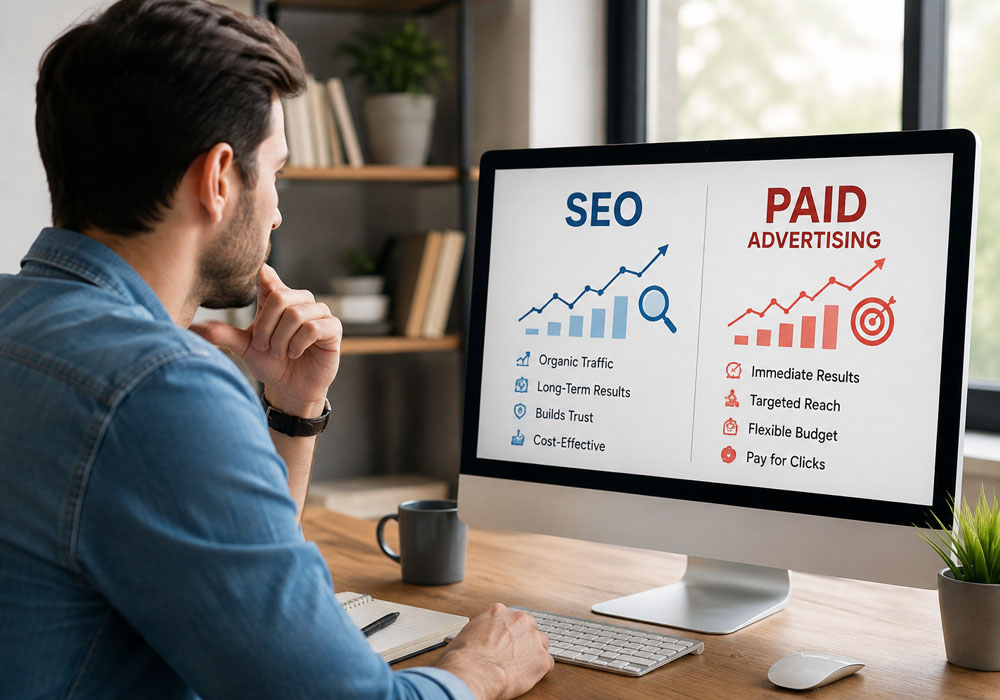
Every marketing budget eventually runs into the same question: put money into search engine optimization or paid ads? Both promise growth, but the timelines and payoffs look nothing alike once you dig into how each one actually performs over months and years.
This article breaks down what each channel really delivers over time, where the true costs hide, and how smart businesses combine both to build growth that lasts well beyond a single ad campaign.
Understanding the Core Difference Between SEO and Paid Advertising
Search engine optimization and paid advertising both aim to put your business in front of people searching for what you offer, but they get there in completely different ways. SEO earns placement through relevance and authority signals search engines trust, while paid ads buy a spot at the top through a bidding auction that runs every single time someone types a query.
Experts from a renowned Minneapolis SEO agency often note that organic rankings build momentum over time in a way ads simply cannot. A page that climbs to the first result this year keeps pulling in clicks next year without any extra spend, and that compounding return is something no ad campaign can replicate once the budget runs dry.
Cost structure sets the two apart just as clearly. Paid ads charge you every time someone clicks, so traffic stops the moment spending stops. SEO asks for an upfront investment in content and technical work, but once a page ranks well, it keeps generating visits at little to no additional cost for months or even years.
Speed tells a different story altogether. Ads can put your business on page one within hours of launching a campaign, which matters when you need customers right away. SEO rarely works that fast. It often takes several months of consistent effort before rankings climb high enough to bring in meaningful traffic.
The Real Cost of Paid Ads Over a 12-Month Period
Average cost per click varies wildly by industry, and it rarely moves in your favor. Legal, insurance, and finance keywords can run past $20 per click, while even modest niches see prices climb every year as more businesses compete for the same handful of ad slots.
Ad fatigue sets in faster than most business owners expect. The same audience sees your ad dozens of times within a few weeks, and click-through rates start dropping even when the creative hasn’t changed. That means you either refresh campaigns constantly or watch performance slide month over month.
Scaling up rarely means scaling efficiently. Doubling your ad spend almost never doubles your leads, since you end up bidding against a wider pool of competitors and reaching audiences further from your ideal customer. As the account matures, growth through ads tends to cost more per result, not less.
Beyond the ad spend itself, most campaigns carry hidden costs that rarely show up in the pitch. Agency retainers, landing page design, conversion tracking setup, and ongoing optimization all add to the bill. Add these together over a year and the true cost of a paid strategy often surprises business owners who only budgeted for clicks.
Why SEO Builds Equity That Ads Can’t
Every article, guide, or product page you publish sticks around long after you hit publish. Unlike an ad that disappears the moment you stop paying, a well-written page keeps working in the background, answering questions and drawing in visitors for as long as it stays relevant to what people search for.
Backlinks work the same way. Each link earned from another website adds a small signal of trust that search engines remember indefinitely. Over months and years, a site with a steady stream of quality links builds a reputation that becomes harder for competitors to match, especially newer ones with no link history at all.
Domain authority grows slowly, but it grows in a direction that rewards patience. A site that has consistently published useful content and earned links for three or four years often outranks newer competitors even when those competitors publish more frequently, simply because trust accumulated over time carries real weight with search algorithms.
Perhaps the clearest advantage shows up the moment you stop actively working on a site. Traffic from ranking pages keeps arriving weeks and months later, while paid traffic drops to zero within minutes of pausing a campaign. That lingering value is exactly what makes SEO feel like an investment rather than an ongoing expense.
Where Paid Advertising Still Wins
New businesses and fresh product launches often can’t afford to wait months for organic rankings to build. Paid ads solve that problem by putting a brand in front of potential customers within days, which matters enormously when a launch date is fixed and early sales momentum determines whether a product survives its first quarter.
Targeting options on paid platforms go far beyond anything organic search allows. You can reach people by age, location, income bracket, past purchase behavior, or even how recently they visited your site. That level of precision lets small budgets reach exactly the right audience instead of hoping the right person finds a page organically.
Testing new messaging takes days with paid ads instead of months. You can run two headlines, three images, or five different offers at once and know within a week which version performs best. SEO offers nothing close to that speed, since ranking changes take time to show up and results are harder to isolate.
Seasonal businesses depend on traffic arriving at exactly the right moment, and ads deliver that with a precision SEO cannot match. A holiday sale, a limited-time promotion, or a weather-dependent service can turn ad spend on and off instantly, capturing demand during a narrow window that organic rankings would take too long to reach.
Combining Both Strategies for Maximum ROI
Running a small ad campaign before committing to a content strategy tells you which keywords actually convert. Instead of guessing which topics will bring in customers, you can test search terms with paid traffic first and then invest writing and link-building effort into the ones that already prove themselves.
Visitors who find your site through organic search rarely convert on their first visit. Retargeting ads bring those same people back with a reminder or a specific offer, turning traffic that SEO already earned for free into paying customers. This combination often costs less than acquiring a brand new visitor through either channel alone.
How you split budget between the two should shift as a business matures. Early-stage companies often lean more heavily on ads because they need revenue now and haven’t built enough content to rank. Established businesses can gradually shift spend toward content and links once organic traffic starts covering a larger share of demand.
Highly competitive industries rarely reward a single channel strategy. Insurance, legal services, and software companies often need both organic content and paid campaigns running at once just to stay visible, since competitors are doing the same. A hybrid approach spreads risk and keeps traffic flowing even if one channel underperforms for a stretch.
Conclusion
Neither strategy wins outright. Paid ads bring speed and precision when a business needs customers now, while SEO builds a foundation that keeps paying off long after the last dollar gets spent on it.
The businesses that grow steadily over years tend to treat these as partners rather than rivals, using ads to fill gaps while search rankings climb, and leaning more on organic traffic as that foundation gets stronger.