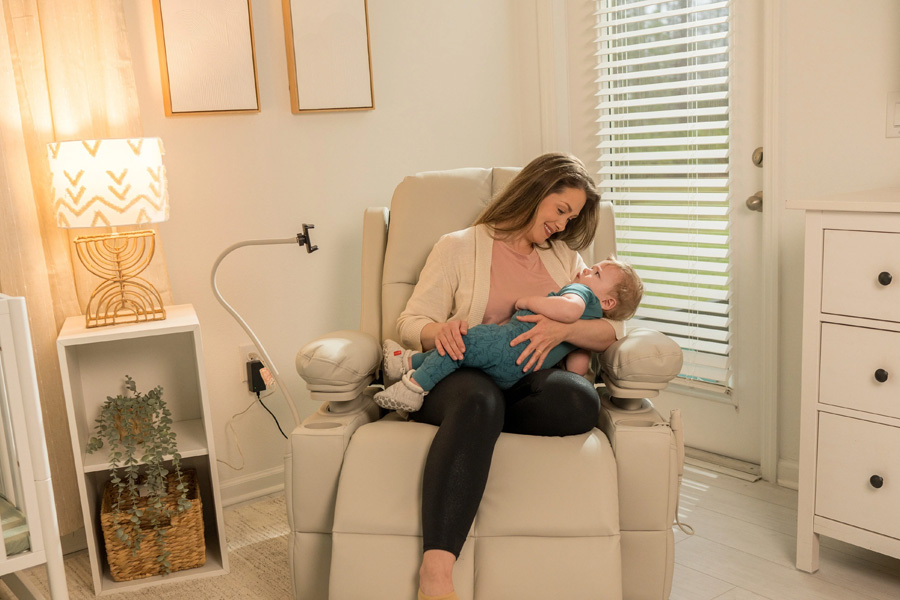
A nursery chair isn’t furniture you just look at. It’s where you’ll sit for hours, often at 3am, feeding a baby who won’t settle anywhere else. Up to 84 percent of breastfeeding mothers report back pain at least once a month, and a big chunk of that comes down to bad posture during feeds. Up to 72 percent develop real musculoskeletal pain from the position they’re stuck holding, night after night. A comfy nursery chair for feeding isn’t a nice extra. It’s a piece of health equipment disguised as a chair, and picking the wrong one costs you months of discomfort.
Why Armrest Height Changes Everything
Your arms hold a baby’s full weight for twenty to forty minutes at a stretch, several times a day. Without armrests at the right height, your shoulders creep up toward your ears without you noticing. That’s how shoulder and neck pain builds, one feed at a time, until it’s a real problem.
I didn’t understand this until I was three weeks in and my neck wouldn’t turn properly. Armrests at elbow height take the weight off your shoulders and put it where it belongs, on the chair.
Glide Motion Versus Rock, Which Actually Settles A Baby
Gliders move in a smooth forward and back motion on a track. Rockers pivot on curved legs. Both can settle a fussy baby, but gliders tend to feel steadier under a moving adult body, especially if you’re also trying to hold a bottle or a phone with your free hand. Rockers can feel tippy if you move weight suddenly.
Neither one is objectively better for every nursery. It depends on your floor space and whether you want the chair to double as regular seating once feeding season ends.
Lumbar Support Isn’t A Luxury Feature
A chair with no lower back support forces you into a slumped position within minutes, and slumping while nursing pulls your head forward, which is exactly the posture linked to that upper cross syndrome pattern physiotherapists warn about. Look for a chair with a curved lower back panel, not just flat cushioning.
Footrests matter here too. Feet flat and knees roughly level with hips keeps your spine in a neutral line instead of twisted or collapsed.
Fabric Choices That Survive Newborn Life
Spit up happens. A lot. Performance fabric or a wipeable weave saves you from a full reupholster six months in. Avoid anything with deep texture that traps stains, no matter how nice it looks in a showroom photo. I’ll be honest, I picked a beautiful boucle chair for my first baby and regretted it by week two.
Washable cushion covers are worth the extra cost upfront. You’ll wash them more than you expect.
Getting The Recline Angle Right For Bonding Time
A chair that reclines slightly helps babies settle into skin to skin contact more easily than a fully upright seat. It’s not about maximum recline, though. Too far back and you lose the ability to maintain eye contact during feeds, which matters for early bonding. A moderate recline with a stable base gives you both comfort and connection in the same seat, which is really the whole point of choosing this piece of furniture carefully in the first place.
Swivel Base, A Small Feature That Saves Your Back
A chair that swivels lets you turn toward a crib or bassinet without twisting your spine to reach in. Small movement, big difference over hundreds of repetitions. I didn’t rate this feature until I had it, then I couldn’t imagine a nursery chair without it. If your budget allows one upgrade beyond the basics, make it this one.