Decorative concrete has quietly moved from commercial lobbies into residential spaces. Here’s what makes it a compelling option and what the installation process actually involves.
Flooring decisions tend to be permanent — not in the sense that they can never change, but in the sense that most homeowners live with their choice for a decade or more before considering a replacement, observes Peoria Property Management. That stakes-raising reality pushes people toward materials they know: hardwood, tile, carpet, luxury vinyl plank. Decorative concrete sits outside that familiar category for most homeowners, which means its genuine advantages often go unconsidered when it would actually be the best choice for the space.
The category includes stamped concrete, stained concrete, epoxy coatings, and polished concrete — each producing a different aesthetic and using different installation methods, but all sharing the fundamental benefit of transforming an existing concrete slab into a finished surface without laying material on top of it. Understanding how these options compare to traditional flooring alternatives makes the choice clearer.
What Stained Concrete Actually Does
Concrete staining is a chemical or water-based coloring process that penetrates the slab surface and creates color within the concrete itself rather than sitting on top of it. Acid staining uses a dilute hydrochloric acid solution with metallic salts that react with the minerals in the concrete to produce variegated, translucent color that is genuinely unique to each slab — the mottled, organic appearance of acid-stained concrete cannot be perfectly replicated because the reaction depends on the specific mineral content of that particular slab. A qualified concrete staining company can show you samples from prior projects but the finished result always has its own character.
Water-based stains produce more predictable, uniform color and a broader palette of colors including ones that acid staining can’t achieve — blues, greens, vivid earth tones. They penetrate the surface less deeply than acid stains but are more consistent and easier to apply uniformly. Both types are finished with a sealer that protects the color, provides sheen from matte to high-gloss depending on the product selected, and makes the surface cleanable. The combination of stain and sealer produces a surface that’s genuinely durable for residential use.
Cost Comparison With Traditional Flooring
The economics of concrete staining look best when you’re working with an existing slab that’s in good condition — which is exactly the situation in most garages, basements, patios, and sunrooms, and in many newer construction homes where the concrete subfloor is accessible. In these cases, the cost of staining and sealing the existing slab is typically less than installing hardwood, tile, or even quality luxury vinyl plank, because you’re not paying for the material itself — only the transformation of what’s already there.
The cost changes significantly if the slab has extensive cracks, surface damage, or other issues that require repair before staining. Concrete staining reveals and accentuates the character of the slab — it doesn’t hide imperfections. Cracks need to be addressed before staining, and the repair becomes part of the visual character of the finished floor. For slabs in poor condition, other flooring options may actually be more economical once repair costs are factored in.
Durability and Maintenance Realities
Concrete floors are genuinely hard — harder than tile, harder than hardwood, harder than any resilient flooring option. This hardness is both an advantage and a practical consideration. On the advantage side, it means the material itself is extremely durable: the color in an acid-stained, sealed concrete floor doesn’t wear through because it’s embedded in the slab. The sealer is the maintenance item — it protects the color and provides the finish, and it needs reapplication periodically depending on traffic and wear.
Residential concrete floors in lower-traffic areas may need resealing every three to five years; high-traffic areas like kitchen floors or garage floors see more wear on the sealer and may need attention more frequently. Resealing is less expensive than refinishing hardwood or replacing tile grout and is well within a motivated homeowner’s DIY capability for straightforward applications. The ongoing maintenance commitment is real but modest compared to hardwood in particular.
Applications Where Stained Concrete Excels
Certain spaces are particularly well-suited to decorative concrete. Patios and covered outdoor living areas are natural applications — concrete is already the standard patio material, and transforming it from bare gray to a stained surface with a decorative border or pattern changes the character of the outdoor space dramatically at a fraction of the cost of replacing it with pavers or tile. Garages and workshops benefit similarly, with epoxy or stain-and-seal treatments that make the space cleaner-looking and easier to maintain.
Interior applications work best in spaces with radiant heat, in contemporary architectural styles that celebrate industrial and natural materials, and in homes where a seamless floor from space to space (no transitions between rooms) is visually appealing. Open-plan living areas where a continuous floor connects the kitchen, dining, and living areas look particularly cohesive with stained concrete. The material is also inherently allergy-friendly — no fibers to trap dust, no adhesive off-gassing — which matters to some households.
What to Expect From the Installation Process
Professional concrete staining typically takes two to four days from start to finish, including surface preparation, the staining process, sealer application, and cure time. The most important phase is surface preparation: the slab needs to be mechanically abraded or chemically etched to open the pores of the concrete for the stain to penetrate. Any existing coatings, adhesives, or contamination from prior floor coverings must be fully removed, because they’ll block the stain from reaching the concrete.
The space needs to be empty during the process and for the cure period afterward. Furniture and fixtures should be removed before work begins. The smell during acid staining is significant — the hydrochloric acid reaction produces fumes that require ventilation. Water-based stains are much lower odor. The sealer application typically requires 24 to 48 hours to cure before foot traffic, and longer before heavy furniture is brought back in. Most contractors include this timeline in their project documentation so you can plan the space disruption accordingly.
Design Possibilities Beyond Basic Staining
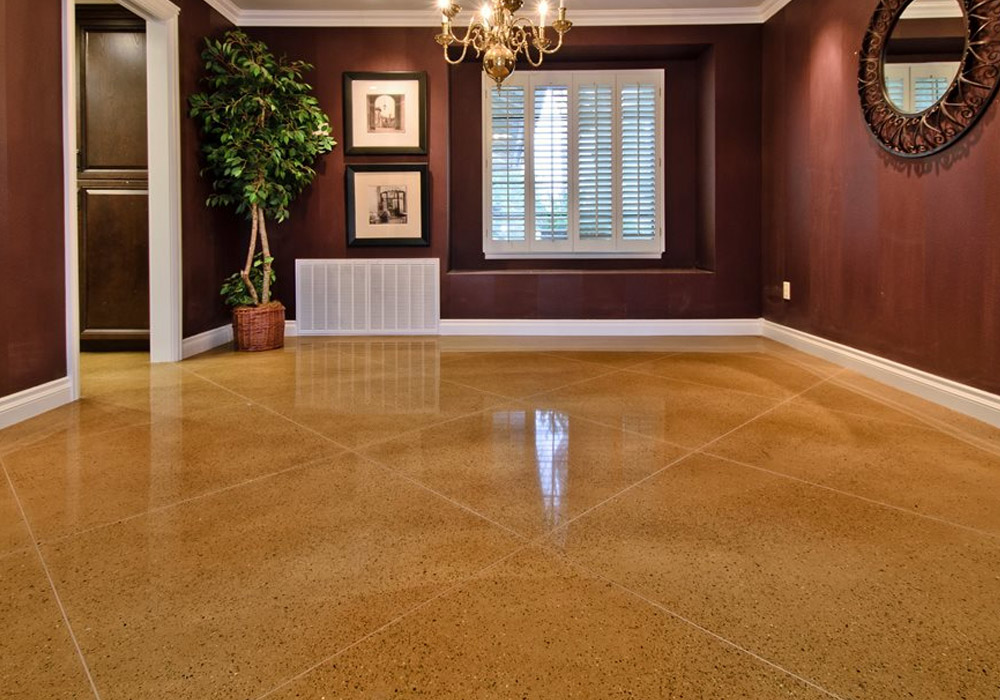
Decorative concrete doesn’t have to mean a monochromatic stained floor. Saw-cutting patterns into the slab before staining allows different sections to be stained in different colors, creating geometric patterns, faux tile layouts, or bordered designs. Stenciling with acid or water-based stains produces repeating patterns. Metallic epoxy systems create swirling, three-dimensional-looking effects that are striking in certain design contexts. Stamped overlays can add texture and pattern to existing slabs that are too damaged for direct staining.
The design versatility of decorative concrete has expanded significantly as products and techniques have developed, to the point where it can authentically approximate the look of natural stone, slate, or wood plank in the right hands. The key distinction from the mimicry of luxury vinyl plank is that concrete has genuine material depth and variation — the aging process of concrete floors tends to produce character rather than uniform wear, which appeals to homeowners who value authenticity in materials.
Wrapping Up
Decorative concrete earns serious consideration when you’re working with an existing slab that’s in good condition and want a durable, unique floor that doesn’t require laying material over what’s already there. The economics favor it in these situations, the durability is genuine, and the design range is broader than most people realize before they start looking at samples. The right concrete staining professional can assess your specific slab, walk through the options for color and finish, and give you a realistic picture of what the finished floor will look like — which is the beginning of a confident decision.
Frequently Asked Questions
Can concrete staining be done over concrete that has been painted?
Usually no, at least not with acid or water-based penetrating stains. These stains need to reach the concrete itself to react or penetrate, and paint creates a barrier that prevents this. The paint must be stripped completely before staining is possible. In some cases paint removal isn’t fully achievable, particularly if the paint has been there for many years or multiple layers have been applied. In these situations, a concrete coating or overlay may be a better option than penetrating stain.
Does stained concrete get slippery when wet?
The sealed surface of decorative concrete can be more slippery when wet than the rough texture of unsealed concrete, particularly with high-gloss sealer finishes. Anti-slip additives mixed into the topcoat sealer create a textured surface that significantly improves wet traction without substantially changing the appearance. For any application where wet conditions are likely — bathrooms, pool decks, exterior patios — specifying an anti-slip finish is the standard recommendation.