Beauty appointments can become surprisingly expensive when several treatments are repeated every few weeks. Nails, brows, hair treatments, facials, and other services may each seem manageable individually, but together they can represent a significant annual expense.
That makes learning a few beauty skills at home appealing. The key is choosing treatments where practice can realistically produce good results without taking unnecessary risks. Some routines are easy to master with basic tools, while others involve chemicals, heat, skin injury, or techniques where a small mistake can become considerably more expensive than the salon appointment you were trying to avoid.
Basic Manicures and Pedicures Are an Obvious Starting Point
You do not need elaborate nail art to make learning basic nail care worthwhile.
Filing nails into a consistent shape, caring for the surrounding skin, applying regular polish neatly, and finishing with a top coat are all skills that improve quickly with repetition. Once the basic supplies have been purchased, the cost per manicure can become very low.
Regular polish is also forgiving. If the result looks terrible, it can simply be removed and attempted again.
More advanced systems require greater care. Gel products, extensions, aggressive cuticle work, and electric nail tools introduce additional opportunities for skin or nail damage. There is no requirement to reproduce every salon technique at home for DIY nail care to be worthwhile.
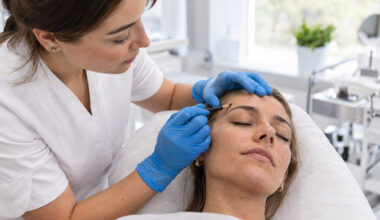
Simple Brow Maintenance Can Save Frequent Appointments
Brows are another area where a little skill can go a long way.
Tweezing obvious stray hairs between professional shaping appointments is relatively straightforward. Trimming unusually long hairs with appropriate scissors can also help maintain an established shape.
The important word is maintain. Completely redesigning your brows is much more difficult than cleaning up a shape that already works.
A useful strategy is to have them professionally shaped first and then photograph the result. As hairs grow back, the original outline provides a reference. Removing a few obvious strays every week is much easier than waiting two months and trying to reconstruct the shape from scratch.
More aggressive chemical brow treatments are a different proposition and may be better left to trained professionals.
Learn a Proper At-Home Facial Routine
A good home facial does not need to imitate every treatment available at a spa.
Cleansing properly, applying skincare in a sensible order, using an appropriate mask occasionally, moisturizing, and protecting the skin from the sun can form a useful routine without attempting procedures designed for professional environments.
The biggest mistake is assuming that stronger automatically means better. Social media can make powerful exfoliating products, chemical treatments, and devices look deceptively simple.
Keep the distinction between skincare and skin procedures clear. A relaxing evening involving cleansing, moisturizer, and a suitable mask is very different from deliberately injuring or aggressively resurfacing the skin.
For ordinary maintenance, consistency generally makes more sense than turning the bathroom into a miniature dermatology clinic.
Hair Masks and Deep Conditioning Are Easy Wins
Some salon services are valuable because they require professional technique. Others are valuable mainly because someone else performs a process that can be inconvenient at home.
Deep conditioning belongs largely in the second category.
Learning how much product your hair actually needs, where to apply it, and how frequently to use it can make at-home treatments much more effective. Someone with dry ends may need a very different routine from someone whose fine hair becomes weighed down easily.
Scalp treatments can also become part of a home routine when appropriate products are used according to their instructions.
The financial advantage becomes clearer over time because these treatments are repeatable. One product may provide numerous applications rather than paying separately for each salon visit.
Certain Hair Color Maintenance Can Be Learned Carefully
Hair coloring sits somewhere between an obvious DIY treatment and something that can go spectacularly wrong.
Maintaining an uncomplicated existing shade is very different from attempting a dramatic color correction. Someone covering straightforward regrowth with a familiar product may eventually become comfortable handling the process at home.
Major transformations are another matter.
Bleaching dark hair substantially lighter, correcting uneven color, creating complicated highlights, or attempting balayage without experience can produce results that are difficult to repair. Hair that has already been chemically processed deserves additional caution.
A useful rule is to consider the consequences of failure. If the worst realistic outcome is slightly imperfect polish, experimentation is relatively inexpensive. If failure could mean seriously damaged hair requiring months of regrowth, paying for expertise begins to look much more reasonable.
Learn Makeup Techniques Instead of Constantly Buying New Products
One of the most cost-effective beauty skills has nothing to do with recreating salon treatments.
Learn to use the makeup you already own.
Understanding foundation placement, blending, blush position, eyeliner, eyebrow definition, and a few different eye looks can change the results more dramatically than repeatedly purchasing new products.
This is also an area where practice carries very little risk. An unsuccessful makeup experiment disappears with cleanser.
For anyone building a more serious home beauty routine, specialist retailers such as https://tadbeauty.com also demonstrate how broad the professional beauty world has become, covering equipment and supplies associated with everything from nails and lashes to salon and spa work. Browsing professional categories can be useful for understanding the difference between ordinary personal-care tools and equipment associated with trained services.
The important part is recognizing that access to professional products does not automatically provide professional technique.
Be Selective About At-Home Hair Removal
Shaving and careful tweezing are obvious home treatments because the techniques are familiar and relatively controllable.
Other hair-removal methods require more judgment.
Waxing involves temperature, technique, skin condition, and correct application. Sensitive areas add further difficulty. At-home light-based hair-removal devices introduce their own requirements and are not appropriate for every combination of hair and skin tone.
Rather than deciding that all hair removal should either happen at home or in a salon, divide it by area and method. You might comfortably handle legs yourself while deciding that another area is worth leaving to an experienced professional.
There is no prize for maximizing the number of beauty treatments performed without assistance.
Know Which Treatments Aren’t Worth the DIY Risk
The strongest home beauty routine includes knowing when not to experiment.
Procedures involving significant skin penetration, powerful chemical peels, removal of moles or other skin lesions, injectable products, and other treatments capable of causing substantial injury should not be approached like learning to paint your nails.
The potential saving has to be compared with the potential downside.
This provides a useful framework for almost any DIY beauty decision. Ask how frequently you need the treatment, how expensive professional appointments are, how much practice is required, what equipment must be purchased, and—most importantly—what happens if you get it wrong.
The best treatments to learn at home tend to be repetitive, relatively forgiving, and easy to improve through practice. Basic nail care, simple brow maintenance, hair conditioning, everyday skincare, and makeup technique can satisfy all three conditions.
A home beauty routine does not have to replace the salon completely. Learning the easy, repeatable jobs yourself can make it much easier to reserve professional appointments for the treatments where expertise genuinely makes the biggest difference.