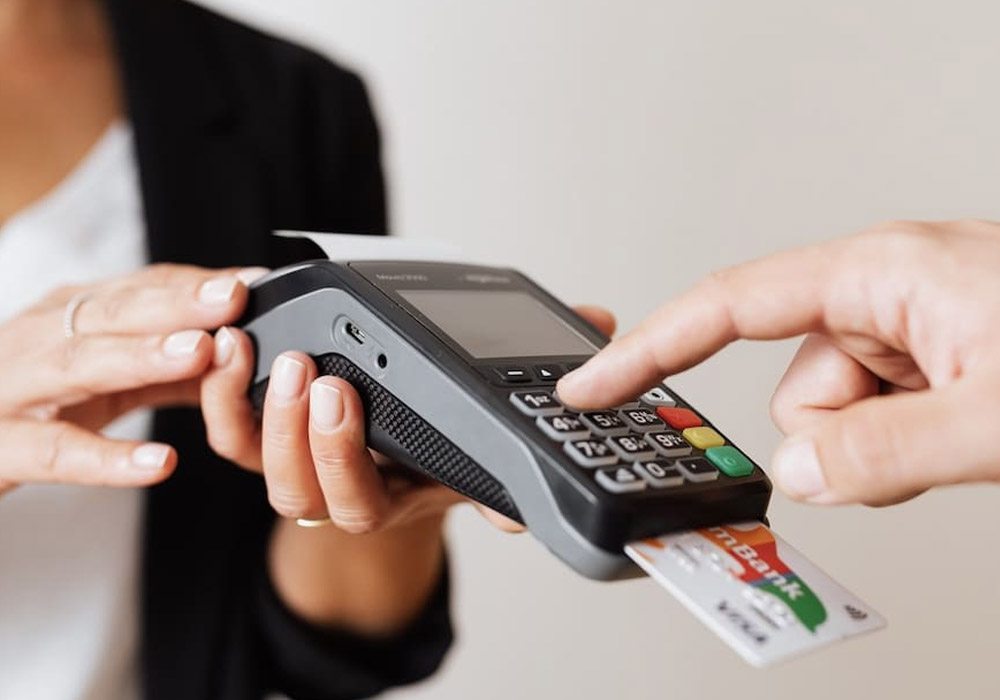
Card acceptance is usually the second-largest line item a liquor retailer pays every month, behind the cost of the product on the shelf. That is why the point-of-sale conversation and the payments conversation keep collapsing into one conversation. A store owner asks which register handles case breaks properly, and within ten minutes is asking who holds the merchant account and what happens to the deposit on a Saturday night.
We looked at eight systems that liquor and package stores actually shortlist, and we scored them on the payments question first: who processes the card, whether you can shop that rate somewhere else, and what the software costs before a single transaction runs. Ratings quoted here come from public review profiles and are noted with their source. Pricing is what each vendor published at the time of writing.
The eight systems at a glance
| System | Best for | Starting software price | Processing model | Public rating |
| WinePOS | Liquor and wine stores wanting payments and case-break inventory from one vendor | $79 per month | In-house processing, flat or Cost+ | 9.3/10, vendor-reported |
| KORONA POS | Owners who want to shop their own processing rate | $59 per month | Processor agnostic | 4.7/5 on Capterra (80 reviews) |
| Bottle POS | Single stores wanting one vendor and a rate-match promise | $59 per month | In-house processing | 3.9/5 on Capterra (16 reviews) |
| mPower Beverage | Stores keeping an existing processor relationship | Quoted; Capterra lists $120 per month | Choice of three vetted partners | 4.1/5 on Capterra (7 reviews) |
| POS Nation | Mixed beer, wine, liquor, and convenience inventories | $49 per month | In-house merchant services | 4.6/5 on Capterra (133 reviews) |
| Lightspeed Retail | Large catalogs across several locations | $89 per month | Lightspeed Payments, built-in | 4.0/5 on Capterra (975 reviews) |
| Square for Retail | New or very small stores opening quickly | $0 free plan, $49 per month for Plus | Square processing only | 4.7/5 on Capterra (493 reviews) |
| Clover | Owners with an existing bank or ISO relationship | Retail bundles commonly quoted at $180 to $240 per month | Bound to the reselling processor | 3.8/5 on Capterra (577 reviews) |
What integrated payment processing actually means at a liquor counter
Integrated payments means the card processing is built into the point of sale software and sold by the same company. One vendor, one contract, one support number, and the card total posts straight back into the sale so the drawer reconciles itself at close. Processor agnostic, sometimes called third party or bring your own processor, means the software will talk to whichever merchant account you already have or whichever one you go shopping for, and the two relationships stay separate. Integrated is simpler to run and harder to renegotiate. Processor agnostic is more work to manage and leaves you free to put your volume out to bid every couple of years. That is the whole trade, and almost every other difference between these systems follows from it.
A few terms worth pinning down before you sit through demos.
- PCI compliance. The Payment Card Industry Data Security Standard is the security rulebook any system touching card data has to meet. The council that maintains it describes the standard as a baseline of requirements designed to protect payment account data, and it applies to merchants, processors, and acquirers alike. An integrated system usually narrows the amount of that burden that lands on you, because encrypted card data never sits in the store’s own environment.
- This is the portion of the card fee that goes to the bank that issued the customer’s card, and it is the part your POS vendor cannot discount. It is also bigger than most owners assume. The Federal Reserve reported that the fee on exempt debit transactions averaged $0.52 in 2023, and exempt covers most of the cards issued by smaller banks and credit unions. On a $14 bottle sale, that is real money.
- Dual pricing and cash discounting. Two names for the practice of posting one price and applying a different one depending on tender, so the card cost lands on the customer who chose the card. Most of the systems below now ship this as a module.
- The processing rate itself. Flat rate means one blended percentage across all card types. Cost+ (also called interchange plus) shows you the wholesale interchange separately from the processor’s markup. Cost+ is harder to read on a statement and usually cheaper at volume.
How we evaluated these systems
We started from the payments architecture, because it is the thing that is expensive to change later. Then we checked liquor-specific inventory handling, particularly whether the system links a single bottle, a pack, and a full case as one item, since that is where general-purpose retail software tends to break. Age verification behavior came next: does the register prompt, does it read a 2D barcode, and does the check get written to the sale record? Finally, we looked at what the vendor publishes openly, because a company that hides its software price usually hides its card rate too. Every rating below is quoted with its source, and no processing savings figure appears anywhere in this article, because none of these vendors publishes one that can be verified.
1. WinePOS: best for wine and liquor stores that want payments and inventory from one vendor
Case breaks are the reason most liquor owners eventually abandon a general retail POS, and this is the specific problem WinePOS was built around. Singles, packs, and full cases link as one item with cost rollups, so selling one bottle out of an open case decrements the case correctly instead of leaving two parallel counts that drift apart by inventory day.
The company has been in this niche a long time. It cites more than forty years of industry-specific experience and over 700 customers, and its payments arm reports processing over $1.7 billion in transaction volume across more than 31 states each year, which is a reasonable proxy for whether the processing side is a real operation or a referral arrangement.
Payments model: In-house processing on either flat or Cost+ rate structures. No rate card is published, so the number comes out of the quote. Surcharge and cash discount programs are offered and described as compliant with state regulations. If you want to keep the processor you already have, treat that as a question for the demo rather than an assumed capability.
Pricing: From $79 per month. The published tiers (Lite through Enterprise) are priced on the number of registers, processing volume, and add-ons, and hardware is a separate one-time cost.
Rating: The homepage publishes a 9.3 out of 10 customer satisfaction score. That is the vendor’s own number, with no stated sample size or methodology, and it should be read as such rather than as a third-party review score.
Standout features:
- Singles, packs, and cases linked as one item with cost rollups, plus partial case receiving and store-to-store transfers
- Age prompt at the register with 2D barcode ID scanning, and the check logged to the sale for compliance records
- Margin reporting down to the individual item, plus dead stock and top mover reports by category
- Cloud and web deployment with iOS and Windows apps, and an offline mode so the lane keeps running through an outage
Where it falls short: There is effectively no third-party review footprint. Profiles exist on Capterra, Software Advice, and TrustRadius, and they carry no published reviews, so a buyer who shortlists by star count has nothing to work with here, while Bottle POS, KORONA POS, and Lightspeed all show visible review counts. Onboarding is demo-led rather than self-serve sign-up, and the $79 entry price sits above the cheapest plug-and-play boxes.
2. KORONA POS: best for owners who want to shop their own processing rate
If the integrated versus agnostic question is the one keeping you up, KORONA POS is the clearest expression of the agnostic side. The company states plainly that it works with any processor and publishes a rate calculator to help merchants compare what they are being quoted. Nothing about the software subscription changes based on who holds your merchant account.
That independence has a cost in coordination. You will have two vendors to call when a terminal stops talking to the register, and you will be the one deciding which of them owns the problem.
Payments model: Processor-agnostic. Merchants select their own processor and negotiate their own rate directly.
Pricing: Core at $59 per month, Retail at $79 per month, and at $99 per month, published openly with no setup fee.
Rating: 4.7 out of 5 on Capterra, based on 80 reviews.
Standout features:
- Works with any processor, so processing can be re-bid without replacing the software
- Flat published subscription tiers with no upfront or setup charges
- Inventory, purchase ordering, and multi-location management built for high SKU retail
- Age verification prompts and loss prevention reporting
Where it falls short: KORONA POS is a general high-volume retail platform with liquor configurations rather than a beverage alcohol product, so the case break and distributor invoice handling is less automatic than what the liquor specialists ship. Hardware is bought separately. And the processing savings only materialize if you actually do the work of shopping the rate.
3. Bottle POS: best for a single store that wants one vendor and a rate-match promise
Bottle POS takes the opposite position from KORONA POS and is candid about it. Payments and software come from the same company, and the pitch is that combining them produces simpler reporting and one support line. The company states that if your existing processor has a better rate, it will match or beat it, which is a useful commitment to get in writing during negotiation.
Fee offset is handled properly here. Dual pricing, surcharging, and cash discounting are all offered, and the vendor frames them as being set up in line with local and state rules rather than as a universal switch.
Payments model: In-house integrated processing. No published rate card, and no documented option to bring an outside processor.
Pricing: The Starter plan is published at $59 per month. Growth and Premium prices are only shown after you complete a pricing configurator.
Rating: 3.9 out of 5 on Capterra, based on 16 reviews.
Standout features:
- Liquor-specific inventory with automated distributor invoice import
- Dual pricing, surcharging and cash discount modules
- Age verification and compliance reporting for beverage alcohol retail
- Rate match or beat commitment against your current processing statement
Where it falls short: Sixteen public reviews is a thin evidence base for a decision this expensive, and the 3.9 average is the second lowest in this comparison. Only the entry tier is publicly priced. And because processing is in-house with no bring-your-own path, the rate match promise is the only bargaining position you have at renewal.
4. mPower Beverage: best for stores that want liquor-specific software and their own processor
Here is the middle position, and it is a genuinely useful one. mPower Beverage is built specifically for beverage alcohol retail, but it does not force its own merchant account on you. The company says merchants are never locked into a single forced processor, that the software integrates with three vetted processing partners, and that you keep your own rates and your own relationship. For an owner who has spent years getting a good rate out of a local bank, that combination is rare.
The catch is visibility. Very little about this company is public, including what it costs.
Payments model: Choice among three vetted processing partners. Merchants keep their existing rate and relationship.
Pricing: Not published. The vendor quotes per store based on register count, number of locations, and capabilities. Capterra lists a starting price of $120 per month.
Rating: 4.1 out of 5 on Capterra, based on 7 reviews.
Standout features:
- Beverage alcohol specific inventory, including case, pack, and single handling
- Keg rental and allocated bottle workflows that general retail systems do not model
- Distributor ordering and invoice reconciliation
- Processor choice across three integration partners
Where it falls short: Seven public reviews and no published price mean you are buying almost entirely on reference calls and the demo. Ask for two or three current customers of a similar size before signing anything, and ask specifically which of the three processing partners they landed on and why.
5. POS Nation: best for mixed beer, wine, liquor and convenience inventories
A lot of package stores are not purely package stores. They sell cigarettes, lottery, snacks and a cooler of single serve, and the register has to handle all of it. POS Nation sells into exactly that blended retail profile, which is why it shows up on nearly every liquor POS roundup even though it is not a beverage alcohol specialist.
On payments the company brought processing in-house. It describes POS Nation Merchant Services as its own in-house payment processing offering, positioned as a turnkey option, while also maintaining partnerships with a number of outside processors. Its dual pricing program, previously marketed as cash discounting, passes the card cost to the customer paying by card.
Payments model: In-house merchant services, with stated partnerships across several outside processors. Rates are quoted, not published.
Pricing: The Starter plan is listed at $49 per month, reduced from $69. Growth and Premium require the pricing configurator. Capterra lists a $149 per month Flex Monthly option.
Rating: 4.6 out of 5 on Capterra, based on 133 reviews.
Standout features:
- Built-in ID scanning and age verification at the register
- Handles mixed retail categories including tobacco, lottery and grocery alongside liquor
- Dual pricing program for offsetting card acceptance cost
- Customer loyalty and house account features for regulars
Where it falls short: Pricing above the Starter tier is not public, and the range between the published $49 and the $149 figure listed on Capterra is wide enough that you cannot budget from it. The liquor features are a configuration of a general retail platform rather than the platform’s reason for existing.
6. Lightspeed Retail: best for large catalogs across several locations
Stores carrying several thousand SKUs across more than one address tend to end up looking at Lightspeed Retail, and the catalog tooling is the reason. Vendor catalogs, purchase ordering, transfers, and reporting across locations are all stronger than what the smaller specialists offer.
Payments come from Lightspeed Payments, the company’s own processing product, which is presented alongside each plan on the public pricing page. Processing is handled inside the POS, so the transaction posts back to the sale automatically.
Payments model: Lightspeed Payments, the vendor’s own integrated processing, priced per plan.
Pricing: Basic at $89 per month, Core at $149 per month plus at $289 per month, as published on the Lightspeed pricing page. Capterra lists the same tiers at $109, $179, and $339, which is the difference between annual and monthly billing.
Rating: 4.0 out of 5 on Capterra, based on 975 reviews. Capterra records 76 percent of that feedback as positive and 17 percent as negative.
Standout features:
- Deep catalog and vendor management across multiple locations
- Purchase ordering, transfers, and consolidated multi-store reporting
- iPad-based front end with a large integration ecosystem
- Built-in processing with rates published against each plan tier
Where it falls short: It is the most expensive software in this comparison by a wide margin, and it is a general retail platform, so liquor-specific behavior like case break linkage and age verification logging is something you configure rather than something you get. The 4.0 average, on by far the largest review base here, reflects a meaningful minority of unhappy customers.
7. Square for Retail: best for a new or very small store opening quickly
Square for Retail earns its place through availability rather than fit. You can be selling this afternoon, the free plan costs nothing monthly, and the rates are printed on a public web page instead of quoted by a rep, which is genuinely unusual in this market.
The trade is total processing lock-in. There is no version of Square where somebody else processes the card. For a store doing modest volume, that is often fine. For a high-volume liquor operation, it removes the single biggest lever you have on cost.
Payments model: Square processing exclusively. No third-party processor option exists.
Pricing: A free plan at $0 per month, Plus at $49 per month per location, and Premium at $149 per month per location. Published in-person card rates are 2.6 percent plus 15 cents on the free plan, 2.5 percent plus 15 cents on Plus, and 2.4 percent plus 15 cents on Premium.
Rating: 4.7 out of 5 on Capterra, based on 493 reviews.
Standout features:
- Published, transparent card rates with no negotiation and no contract
- Free tier with no monthly software cost
- Fast setup with hardware available off the shelf
- Ecommerce, delivery and online ordering built into the same account
Where it falls short: No processor choice at all, which is the opposite of what most established liquor retailers want. Case and pack inventory relationships need workarounds or third-party apps, and age verification is not a native register workflow the way it is in the liquor-specific systems.
8. Clover: best for owners who already have a bank or ISO relationship
Clover is a capable machine that ranks last in this particular comparison because of how it is sold, which is worth separating from what it does. It is a payments platform first and a retail platform second, and the hardware normally reaches you through a bank, an independent sales organization, or a merchant services agent rather than through the manufacturer. That reseller model determines almost everything about the experience, including your rate and who answers when something breaks.
If your bank has already put a Clover device on your counter and the relationship works, the argument for staying is real. If you are starting from a blank page, the pricing opacity is a problem.
Payments model: Processing is bound to whichever bank, ISO, or agent sold you the system. Rates are set by that reseller, not by a public rate card.
Pricing: Retail packages are commonly quoted between roughly $180 and $240 per month, with card-present processing typically quoted at 2.6 percent plus 10 cents on the entry tier and 2.5 percent plus 10 cents above it. Capterra lists Clover’s pricing as vendor-quoted rather than published.
Rating: 3.8 out of 5 on Capterra, based on 577 reviews, the lowest average in this comparison.
Standout features:
- Large app marketplace covering loyalty, scheduling, and reporting add-ons
- Well-built countertop and handheld hardware with strong offline behavior
- Widely supported by banks and merchant services providers across the country
- Age verification and inventory apps available through the marketplace
Where it falls short: Reviewers on Capterra repeatedly flag support quality and unexpected recurring charges, which is largely a function of the reseller layer rather than the product. Multi-year terms are common. And because the device is tied to the processor who sold it, switching processors usually means switching hardware.
Choosing between integrated and processor-agnostic for your own store
Start with your monthly card volume, because the answer changes at scale. A store running $40,000 a month through the terminals is not going to recover much by re-bidding processing, and the operational simplicity of one vendor is worth more than the fraction of a point on the table. A store running $400,000 a month is in a different position, and the ability to put that volume out to bid every two or three years is worth accepting a second vendor relationship.
Then look at what you already have. Owners with a long-standing bank relationship and a rate they negotiated years ago usually want processor-agnostic software, which points toward KORONA POS or mPower Beverage. Owners who are tired of being the integration layer between two vendors usually want the opposite, which points toward WinePOS, Bottle POS, or POS Nation.
Read the general purpose field carefully. Square for Retail, Clover, Lightspeed Retail, and enterprise systems such as NCR Voyix are all capable retail platforms, and NCR Voyix in particular is built for large multi-location chains and sold through resellers on quoted pricing. None of them were designed around beverage alcohol, so case breaks, distributor invoices, and age verification logging are configuration work rather than defaults. That is a fair trade for some stores and a daily irritation for others.
Ask three questions in every demo. What happens to my rate at renewal, and is that in the contract or in a rate sheet the vendor can change? Does the age verification check get written to the transaction record, or does it just prompt the cashier and disappear? And if I break a case at the register, does the system decrement the case or create a second, separate count that I will be reconciling by hand in six months?
Questions liquor retailers ask about POS payment processing
Which POS systems support integrated payment processing for liquor stores?
Of the systems here, WinePOS, Bottle POS, POS Nation, Lightspeed Retail, Square for Retail and Clover all process cards themselves. KORONA POS is processor-agnostic and works with whichever merchant account you bring. mPower Beverage sits in between, integrating with three vetted processing partners while letting you keep your own rate and relationship.
How do Clover, Lightspeed and Square for Retail compare on integrated payments?
All three are integrated, but they differ on who sets the price. Square publishes its in-person rates openly and does not negotiate them, which makes budgeting easy and re-bidding impossible. Lightspeed sells Lightspeed Payments as part of its plans and publishes rates against each tier. Clover’s rate is set by the bank, or independent sales organization that sold you the device, so two stores running identical Clover hardware can end up paying very different rates for the same transaction. If predictability is what you are after, Square is the one to look at. If you need the deeper retail feature set and are willing to pay for it, that is Lightspeed.
Do these systems keep me PCI compliant?
Integrated systems reduce your PCI scope because encrypted card data is handled by the processor’s environment rather than stored on your register. They do not make compliance automatic. You still complete an annual self-assessment questionnaire, maintain network security at the store, and control who has access to what. Treat any vendor claim of guaranteed compliance with suspicion.
How should I price out the total cost, including card processing?
Add three things. The software subscription, which for these systems runs from $0 to $289 per month per location. The hardware, which is a separate one-time cost almost everywhere and can run to several thousand dollars for a multi-lane store. Then the card cost, which you should model as a percentage of your actual monthly card volume rather than as a rate you compare in the abstract. A tenth of a point sounds trivial until you apply it to a year of sales.
Is dual pricing or cash discounting legal in my state?
Rules vary by state and by card brand, and they have changed repeatedly. Under federal lending rules, a discount offered to induce payment by cash rather than card has long been treated differently from a surcharge. The Consumer Financial Protection Bureau’s regulation text on finance charges excludes discounts offered to induce payment by cash, check or other means. The practical implication is that how you post and label the price matters as much as the amount, so get your specific program reviewed rather than trusting a vendor module’s default settings.
Which of these handle age verification and ID checks properly?
WinePOS, Bottle POS, POS Nation and mPower Beverage all include age verification designed for beverage alcohol retail, with 2D barcode ID scanning available and the check recorded against the sale. Lightspeed Retail and Square for Retail rely more on prompts and third-party apps. Ask specifically whether the check is written to the transaction record, because a prompt the cashier clicks through leaves you nothing to produce during an inspection.
Will my liquor license or alcohol category cause a problem with underwriting?
Beverage alcohol is not a prohibited category, but processors underwrite it more carefully than general retail, and they will typically want your license, your ownership documentation, and recent processing statements. Delivery and online ordering add another layer of questions. Ask any prospective processor about beverage alcohol underwriting before you commit to the software, because discovering a problem after installation is an expensive sequence of events.
The bottom line
The processing question deserves to be settled before the software question, because software you can migrate in a weekend and a five-year processing relationship you cannot. If you want to keep shopping your rate, KORONA POS and mPower Beverage are the two systems here that make that easy. If your volume does not justify the effort and you would rather have one vendor accountable for the whole counter, the integrated systems are the shorter path.
For a wine and liquor store specifically, the case break problem and the age verification record are the two things a general-purpose retail platform will not solve for you, and they are worth more than a slightly better rate. If you are shortlisting a liquor store POS with integrated payment processing and you want the inventory model built for cases, packs and singles rather than bolted on afterwards, WinePOS is built for that category and processes cards itself. Whichever way you go, get the renewal rate in the contract.